Articles

Abstract: Tracing the 2,000-year history of Christian systematic thought. From early church universalism to Reformation predestination, discover how the church’s greatest minds wrestled with the paradox of divine sovereignty and human freedom—and how the shifting political tides of history helped shape the doctrines we inherit today. This is Part 1
Read More
Abstract: Tracing the 2,000-year history of Christian systematic thought. From early church universalism to Reformation predestination, discover how the church’s greatest minds wrestled with the paradox of divine sovereignty and human freedom—and how the shifting political tides of history helped shape the doctrines we inherit today. This is Part 2 (final)
Read More
This deep-dive journey tracks the trajectory of Christian thought from the Apostle Paul’s letters straight to the front lines of twenty-first-century medical law. By unpacking the Book of Romans, our conversation demonstrates how Paul systematically constructed an unbroken worldview... Along the way, we pressure-test this biblical framework against history's greatest intellectual heavyweights... Finally, maintaining a “renewed mind,” we confront the digital frontier, demonstrating how the Imago Dei (Image of God) serves as our ultimate shield to defend human sanctity against the illusions of machine consciousness and the neo-Gnostic traps of transhumanism. Part 1
Read More
This deep-dive journey tracks the trajectory of Christian thought from the Apostle Paul’s letters straight to the front lines of twenty-first-century medical law. By unpacking the Book of Romans, our conversation demonstrates how Paul systematically constructed an unbroken worldview... Along the way, we pressure-test this biblical framework against history's greatest intellectual heavyweights... Finally, maintaining a “renewed mind,” we confront the digital frontier, demonstrating how the Imago Dei (Image of God) serves as our ultimate shield to defend human sanctity against the illusions of machine consciousness and the neo-Gnostic traps of transhumanism. Part 2
Read More
This deep-dive journey tracks the trajectory of Christian thought from the Apostle Paul’s letters straight to the front lines of twenty-first-century medical law. By unpacking the Book of Romans, our conversation demonstrates how Paul systematically constructed an unbroken worldview... Along the way, we pressure-test this biblical framework against history's greatest intellectual heavyweights... Finally, maintaining a “renewed mind,” we confront the digital frontier, demonstrating how the Imago Dei (Image of God) serves as our ultimate shield to defend human sanctity against the illusions of machine consciousness and the neo-Gnostic traps of transhumanism. Part 3
Read More
This deep-dive journey tracks the trajectory of Christian thought from the Apostle Paul’s letters straight to the front lines of twenty-first-century medical law. By unpacking the Book of Romans, our conversation demonstrates how Paul systematically constructed an unbroken worldview... Along the way, we pressure-test this biblical framework against history's greatest intellectual heavyweights... Finally, maintaining a “renewed mind,” we confront the digital frontier, demonstrating how the Imago Dei (Image of God) serves as our ultimate shield to defend human sanctity against the illusions of machine consciousness and the neo-Gnostic traps of transhumanism. Part 4 (final)
Read More
Artificial Intelligence can become a powerful tool for Bible study—not by replacing Scripture, faith, or personal responsibility, but by helping us examine our interpretations more carefully. Adversarial Bible Study is an approach that deliberately challenges our theological assumptions. Instead of asking AI simply to confirm what we already believe, we ask it to present the strongest biblical case for and against an interpretation, identify hidden assumptions, examine the original-language context, compare relevant passages, and distinguish what Scripture explicitly states from what we infer from it. This approach encourages us to ask important questions: What does the text actually say? What am I assuming? Am I importing a theological definition into the passage? Does my interpretation account for all the relevant Scriptures? What passages challenge my position? What evidence would cause me to reconsider my conclusion? Used responsibly, AI can function as a research assistant, analytical partner, and adversarial challenger. It can help expose gaps in our reasoning, uncover passages we may have overlooked, and force us to engage seriously with interpretations different from our own. The authority, however, remains with Scripture—not the AI. The Christian remains responsible for examining the evidence, reading the biblical text in context, exercising discernment, and ultimately forming theological conclusions. The goal is not to make AI the authority over the Bible, but to use AI to become more careful, honest, rigorous, and accountable students of God's Word.
Read More
“Corporeal God” examines scholarly arguments that the God portrayed in the Hebrew Bible and early Christianity is often depicted as embodied, visible, and human-shaped, in contrast to later doctrinal claims that God is strictly immaterial. Drawing on a discussion prompted by Google AI, the article highlights how modern theologians and biblical scholars reassess biblical language and narratives that present God in tangible, perceivable forms. It introduces key voices in this renewed conversation, beginning with Jewish theologian and biblical scholar Benjamin D. Sommer and his influential contributions to the embodied-view debate.
Read More
“Corporeal God, Part 2” continues a dialogue-driven examination showing that the “wholly other” view of God was largely shaped by Greek philosophy and later theological systems than by the clear texts of Scripture. A large number of scriptures are presented that support the Corporeal view of God.
Read More
“Corporeal God, Part 3” examines the presuppositions of Classical Theology—such as creation ex nihilo, the notions of a spaceless and timeless divine being, and the doctrines of divine immutability, impassibility, and simplicity. It contends that literal realism, rather than abstract philosophical constructs, provides the truest framework for understanding God and the universe.
Read More
“Corporeal God, Part 4” articulates the newly established core axioms, engaging the theomorphic perspective (humanity created in the image of God) and addressing the hard problem of consciousness and qualia—the subjective texture of existence, such as perceiving the color blue or experiencing joy.
Read More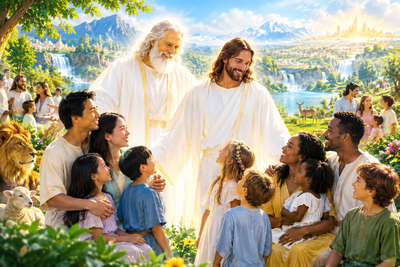
This thesis: Corporeal Panentheistic Personalism posits that the living God is embodied, inherently dynamic, complex and active under His own volition, not the static Neo-Platonic abstractions (simplicity, immutability, impassibility) that prevent genuine relationship. Infinite, empty Space is not a rival entity to God, but the eternal horizon and arena that contextualizes His localized, embodied existence as its supreme Nucleus. Reality was created ex deo (out of God's own divine substance) rather than ex nihilo (out of nothing), bridging the gap between creator and creation. Eternal Conscious Torment (ECT) is rejected as morally and scripturally flawed. Trials and death are temporary, corrective phases. Citing Pauline theology (such as Colossians and 1 Corinthians), the framework posits that all discordant elements will eventually be healed and reconciled, culminating in a perfected divine family where God is "All in All." The Cross is seen as the ultimate climax of cosmic history and the absolute satisfaction of cosmic justice. Salvation is metamorphosis of the soul (transformation of the body).
Read More