Why Use AI in Bible Study
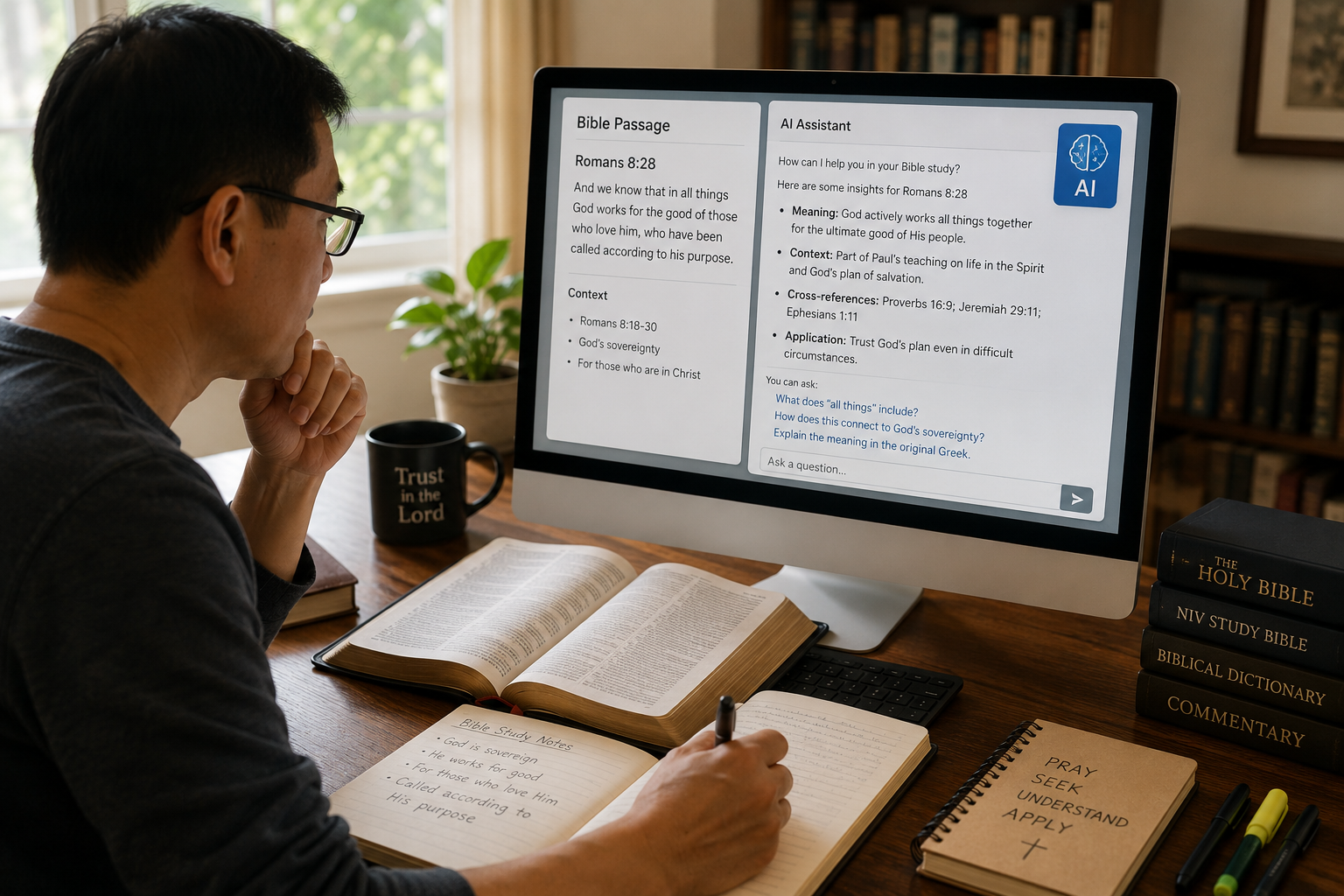
(A) Some Christians fear using AI for Bible Study. Can you respond to this concern?
ChatGPT Answer:
Yes. The fear is understandable, especially among Christians who rightly believe that Scripture is the authority, not human wisdom. But I think the fear can be addressed by making an important distinction:
AI should be treated as a study tool, not as an authority.
The real question is not “Can AI study the Bible?” but “How do I use AI without allowing it to replace Scripture, the Holy Spirit, sound reasoning, or my responsibility as a believer?”
1. AI is not the source of biblical authority.
For a Christian, the hierarchy should remain:
God → Scripture → careful interpretation → tools that assist our study
not:
AI → interpretation → Scripture
AI has no divine authority. It can summarize, compare translations, identify Greek/Hebrew terms, find connections between passages, and present arguments—but its conclusions must always be tested against Scripture.
The Bereans provide an excellent model:
“They received the word with all readiness of mind, and searched the scriptures daily, whether those things were so.”— Acts 17:11
Notice that they tested what they were taught against Scripture. The same principle applies to AI.
2. AI can be wrong—and Christians should expect that
AI can:
- misunderstand a passage
- give an incorrect Greek or Hebrew explanation
- confuse historical contexts
- quote a verse inaccurately
- harmonize passages that shouldn't be harmonized
- reproduce popular theological assumptions
- present a denominational interpretation as though it were obvious biblical fact
- confidently state something that is simply false
That is not a reason to avoid AI. It is a reason not to trust AI blindly.
In fact, this can become a useful discipline: whenever AI makes a theological claim, ask:
“Where does Scripture actually say that?”
Then examine the passage yourself.
3. AI can actually help expose theological assumptions
This is one of its most interesting uses.
Suppose someone asks:
“Does the Bible actually say that the dead are consciously alive in heaven?”
AI can gather passages such as Ecclesiastes 9:5, Psalm 146:4, Psalm 115:17, and others—and then examine passages that appear to teach consciousness after death.
That allows you to put both sides of the evidence on the table.
Similarly, you can ask:
“Give me the strongest arguments for and against the Trinity from Scripture.”
Or:
“Show me every passage that appears to teach an immortal soul.”
Or:
“Separate what this passage actually says from theological conclusions commonly drawn from it.”
That can be extremely valuable because it forces us to distinguish the biblical text from the theological system built around the text.
4. But AI should never become a substitute for reading Scripture
This is probably the greatest danger.
If someone asks AI:
“What does Romans 4 mean?”
and simply accepts the answer, nothing has really been gained.
A much better approach is:
Read Romans 4 → observe the text → formulate your own understanding → ask AI questions → examine alternative interpretations → return to Romans 4 → decide whether the evidence supports the conclusion.
AI becomes a conversation partner and research assistant, rather than a preacher.
5. AI can be particularly useful for asking questions we might not think of
For example, when studying a passage, you can ask:
- Who wrote this?
- Who was the immediate audience?
- What was happening historically?
- What comes immediately before and after it?
- What words are repeated?
- What are the important Greek/Hebrew words?
- What does the passage explicitly say?
- What does it not say?
- What assumptions am I bringing into the passage?
- How was this passage understood in its immediate context?
- What passages appear to contradict my interpretation?
- What is the strongest argument against my interpretation?
- Is this conclusion explicitly stated, or am I inferring it?
- Does Paul teach this elsewhere?
- Does the same author use this word elsewhere?
- Are there differences between the teaching of Jesus, Peter, James, John and Paul that need to be considered?
Those are good Bible-study questions regardless of whether the research assistant is a concordance, commentary, computer program, or AI.
6. The danger is not AI itself—it is misplaced trust
There is an interesting parallel with printed commentaries.
A Christian might say:
“I don't trust AI because it can be wrong.”
Fair enough.
But a commentary can also be wrong.
A pastor can be wrong.
A seminary professor can be wrong.
A Bible dictionary can be wrong.
A translation can contain interpretive decisions.
Even our own understanding can be wrong.
The biblical solution isn't to eliminate every fallible tool. It is to test what we hear.
“Prove all things; hold fast that which is good.”— 1 Thessalonians 5:21
7. There is one particularly good way to use AI
I would encourage Christians to use AI adversarially rather than passively.
Don't merely ask:
“Tell me what this verse means.”
Instead ask:
“I currently believe X. Show me the strongest biblical evidence against X.”
Then:
“Now show me the strongest response to those objections.”
Then:
“Which conclusions are explicitly stated by Scripture, and which are theological inferences?”
That is much closer to Berean Bible study than simply asking AI for an answer.
8. And there is an important spiritual boundary
AI cannot:
- pray for you
- worship God for you
- replace fellowship with other believers
- replace obedience
- give you spiritual regeneration
- become your conscience
- become your Lord
- speak with divine authority
It is a machine that processes information.
The Christian's relationship remains with God through Christ, not with AI.
So I would put the principle this way:
Don't fear using AI for Bible study. Fear using anything—including AI, theology, tradition, pastors, commentaries, or even your own reasoning—as a substitute for God's Word.
Used properly, AI can actually encourage more careful examination of Scripture, because you can make it continually expose assumptions, compare interpretations, search for counterexamples, and distinguish what the text says from what interpreters say the text means.
And given the kinds of questions we've been examining—such as the state of the dead, Paul's distinctive teaching, the Mystery, the soul, and the difference between biblical concepts and later philosophical theology—AI is particularly useful when we make one rule explicit:
Scripture gets the final vote; AI gets no vote at all.
If you want, I can:
�Explore how to use AI adversarially in Bible study
�List practical guidelines for integrating AI with Scripture study
�Discuss specific examples of AI exposing theological assumptions
(B) Explore how to use AI adversarially in Bible study
(Or, Explain step-by-step how to use AI adversarially in Bible study, including example questions to challenge beliefs and examine biblical evidence both for and against them while distinguishing explicit scriptural statements from theological inferences.)
ChatGPT Answer:
Absolutely. I would approach adversarial Bible study as a disciplined way of trying to disprove your own interpretation rather than trying to get AI to confirm what you already believe.
The goal is not to make AI the judge of Scripture. The goal is to make AI a sparring partner that continually asks, “Are you sure the text actually says that?”
1. Start with the biblical text, not a doctrine
Begin by reading the passage yourself.
Don't start with:
“Does the Bible teach unconsciousness after death?”
Start with:
“What does Ecclesiastes 9:5–6 actually say?”
Then record your observations before consulting AI.
For example:
Observation:
Ecclesiastes says that the dead “know not any thing” and that their love, hatred and envy have perished.
At this stage, don't explain why. Just identify what the text says.
This creates an important distinction:
Text → observation → interpretation → doctrine
rather than:
Doctrine → find verses → interpret verses to fit doctrine
2. Ask AI to separate observation from interpretation
This is one of the most valuable prompts you can use.
Ask:
“Examine this passage. First list only what the text explicitly states. Do not explain its theological meaning yet. Then separately list reasonable inferences that could be drawn from it.”
For example:
Explicit statement
“The dead know not any thing.”
Inference
“Therefore, the dead have no conscious awareness.”
The second proposition may be a very reasonable inference, but it is not grammatically identical to the first statement.
That distinction matters enormously in theological discussion.
3. Create three categories of claims
I recommend using three levels.
Level 1 — Explicit Scripture
Something Scripture directly states.
Example:
“The dead know not any thing.”— Ecclesiastes 9:5
Level 2 — Strong biblical inference
A conclusion that follows naturally from several explicit statements.
Example:
The Bible repeatedly describes death as involving the cessation of thought, activity and praise; therefore, the dead appear to be unconscious.
Level 3 — Theological construction
A broader doctrine constructed by combining numerous passages and interpretive assumptions.
For example:
“The human soul is an immaterial conscious entity that survives bodily death and continues personal consciousness.”
That is a much larger proposition than any single biblical statement.
Ask AI:
“Classify every claim in this argument as (1) explicit Scripture, (2) strong inference, or (3) theological construction. Explain why.”
This is extremely useful for exposing where a theological system has gone beyond the actual wording of Scripture.
4. Now attack your own position
Suppose your current belief is:
“The dead are unconscious until the resurrection.”
Don't ask AI:
“Prove that the dead are unconscious.”
That invites confirmation bias.
Instead ask:
“Assume that my belief that the dead are unconscious is wrong. What are the strongest biblical passages that could challenge it?”
Then ask:
“Give me the strongest interpretation of those passages in favor of consciousness after death.”
Don't settle for weak objections. Ask AI to construct the strongest possible opposing case.
This is crucial.
5. Then reverse the exercise
Once you've heard the opposing argument, ask:
“Now critically examine that argument from Scripture. What are its strongest points, and where does it depend upon assumptions that aren't explicitly stated in the text?”
You are effectively conducting a theological courtroom:
Your position → prosecution → defense → cross-examination
That is much more rigorous than asking AI to agree with you.
6. Ask AI to produce the evidence against your favorite interpretation
This is one of my favorite techniques.
Suppose you believe:
“Paul teaches something different from the Twelve concerning the Mystery.”
Ask:
“Give me the strongest biblical case that Paul does NOT have a distinctive revelation or gospel.”
Then:
“Now give me the strongest biblical case that Paul DOES have a distinctive revelation.”
Then:
“Compare the two cases without deciding which one is correct.”
Only after seeing both should you evaluate the evidence.
This protects you from turning AI into an echo chamber.
7. Ask: “What would falsify my interpretation?”
This is perhaps the most powerful adversarial question.
For any doctrine, ask:
“What biblical evidence, if clearly established, would demonstrate that this interpretation is wrong?”
For example:
“If I believe the dead are unconscious, what passages would genuinely falsify that position?”
Or:
“If I believe Paul's gospel contains distinctive revelation concerning the Mystery, what biblical evidence would demonstrate that it does not?”
A belief that cannot possibly be challenged becomes very difficult to distinguish from an assumption.
8. Examine the opposing passages individually
Don't allow AI to produce a giant list of “proof texts.”
Take each important passage separately.
For example:
“Examine Luke 23:43. What does the Greek grammar actually permit? What are the major interpretations of the punctuation? Which conclusions are explicit, and which are inferred?”
Then:
“Now examine Philippians 1:21–23.”
Then:
“Now examine 2 Corinthians 5:1–8.”
Then:
“Now compare those passages with Ecclesiastes 9:5–6, Psalm 115:17, Psalm 146:4 and Daniel 12:2.”
This prevents one difficult verse from being allowed to overturn dozens of other passages without examination.
9. Ask AI to distinguish words from theological definitions
This is particularly important with words such as:
- soul
- spirit
- death
- hell
- heaven
- eternal
- everlasting
- flesh
- church
- kingdom
- gospel
- salvation
For example, don't ask:
“Does the soul survive death?”
Ask:
“List every major way the Hebrew word nephesh is used in the Old Testament. Does nephesh inherently mean an immortal immaterial conscious entity? Distinguish what the word means in its various contexts from later theological definitions of ‘soul.’”
Then do the same with the Greek psyche.
This helps prevent a common mistake:
Taking a later theological definition and reading that definition backward into every biblical occurrence of the word.
10. Ask AI to identify hidden assumptions
This is where adversarial study becomes especially powerful.
Give AI an argument and ask:
“Identify every unstated assumption in this argument.”
For example:
“Jesus said, ‘Today you will be with me in paradise.’ Therefore, all humans possess conscious immortal souls that immediately enter heaven at death.”
AI should be able to identify that this conclusion contains multiple additional propositions that aren't contained in the statement itself.
You can then examine each proposition separately.
Ask:
“Which of these assumptions are explicitly taught elsewhere in Scripture?”
That turns one theological conclusion into several testable biblical claims.
11. Ask for the strongest alternative explanations
Suppose a passage appears to contradict your interpretation.
Don't immediately dismiss it.
Ask:
“Give me five plausible interpretations of this passage, ranked by how well each accounts for the immediate context.”
Then:
“What evidence would favor interpretation #1 over #2?”
And:
“What evidence would make interpretation #1 untenable?”
This forces interpretation to remain evidence-driven.
12. Examine the context at multiple levels
For important passages, ask AI to examine:
Immediate context
The verses immediately surrounding the passage.
Book context
What the author is doing throughout the book.
Authorial context
How that author uses the same terminology elsewhere.
Biblical context
How other biblical writers use the concept.
Historical context
What was happening to the original audience.
Then ask:
“Does the proposed interpretation fit all four levels, or does it depend primarily on one isolated verse?”
13. Ask AI to distinguish “the Bible says” from “Christians commonly believe”
This is an excellent safeguard.
Ask:
“Give me two columns: (A) what the biblical text explicitly teaches, and (B) what later Christian theology commonly teaches about this subject. Do not assume that the two are identical.”
That distinction can be illuminating.
For example, you might discover that:
Biblical statement:
“The dead know not any thing.”
versus:
Theological proposition:
“The body dies but an immaterial conscious soul continues experiencing personal existence.”
The second proposition may or may not be defensible—but it should not simply be presented as though Scripture had stated it verbatim.
14. Make AI argue both sides without telling you which side is correct
This is another excellent technique.
Prompt:
“Construct the strongest biblical argument for position A. Do not criticize it.”
Then:
“Now construct the strongest biblical argument for position B. Do not criticize it.”
Then:
“Now act as an impartial judge. Compare the arguments solely according to explicit biblical evidence, immediate context, cross-references, linguistic evidence and necessary inference. Identify where either side goes beyond Scripture.”
This three-stage approach is much better than:
“Which doctrine is correct?”
because you get to see the reasoning before receiving the conclusion.
15. Ask AI to identify circular reasoning
Theological arguments can sometimes become circular.
For example:
“The soul is immortal because the Bible teaches that the soul survives death.”
Then someone uses a verse translated using the assumption of an immortal soul to prove that the soul is immortal.
Ask:
“Is this argument circular? Does the conclusion already appear as an assumption in the interpretation of the evidence?”
This is especially important when examining translations and theological vocabulary.
16. Ask AI to challenge translation-dependent conclusions
When a doctrine depends heavily upon one English rendering, ask:
“Show me the underlying Hebrew/Greek and the range of legitimate translations. Does the doctrine depend upon one particular English translation?”
Then:
“Would the argument remain valid if the verse were translated differently?”
That doesn't mean Greek or Hebrew automatically settles a question. It simply prevents a theological argument from hiding inside an English translation choice.
17. Finally, return to Scripture without AI
This final step is important.
After all the analysis, close the AI conversation.
Read the passages again.
Ask yourself:
What does Scripture explicitly say?
What is a necessary inference?
What is merely possible? What have I assumed?
What passages challenge my conclusion?
Does my interpretation explain the whole body of evidence?
Am I accepting something because Scripture teaches it—or because it fits my existing theological framework?
Then form your conclusion.
That is where your judgment comes in.
A reusable “Adversarial Bible Study” prompt
You could actually keep a standard prompt like this:
“I want to examine this doctrine without confirmation bias. Do not assume my position is correct. First identify exactly what Scripture explicitly states about the subject. Then identify reasonable biblical inferences. Then identify theological conclusions that go beyond explicit statements. Present the strongest biblical arguments for my position and the strongest biblical arguments against it. Examine the immediate context, broader book context, authorial usage, relevant Hebrew/Greek terminology, and parallel passages. Identify any hidden assumptions, circular reasoning, translation-dependent arguments, or arguments from silence. Tell me what evidence would falsify my position. Do not resolve apparent contradictions by simply harmonizing them; explain the tension first. Finally, give me a balanced assessment of which conclusions are explicit, strongly inferred, possible, or unsupported.”
That is a very different way of using AI from simply asking, “What does the Bible teach?”
The fundamental rule
I would reduce the entire method to one principle:
Don't ask AI to give you the answer. Ask AI to help you test whether your answer survives Scripture.
And there is an even deeper principle:
The objective isn't to prove that I am right. The objective is to discover whether what I believe is actually true.
That attitude is very compatible with Acts 17:11. The Bereans didn't reject teaching because it came from another person, nor did they accept it merely because the teacher was impressive. They searched the Scriptures to see whether the things they heard were so.
That is probably the healthiest way for a Christian to use AI in Bible study.
(C) Give detailed examples illustrating how AI can expose theological assumptions, such as contrasting passages or interpretations about soul immortality or the state of the dead, clarifying what Scripture explicitly says versus theological conclusions.
ChatGPT Answer:
Yes. This is where adversarial AI-assisted Bible study becomes particularly useful. The key is to make AI slow down the movement from a biblical statement to a theological conclusion.
Below are several worked examples.
1. “The soul is immortal”
This is an excellent example because the statement sounds biblical, but it is actually a theological proposition that needs to be demonstrated.
Step 1 — State the doctrine
Claim: “Every human possesses an immortal soul that continues conscious existence after bodily death.”
Now ask AI:
“Break this statement into its individual propositions. Which of those propositions does Scripture explicitly state?”
You might get something like:
- Humans possess a “soul.”
- The soul can exist independently of the body.
- The soul remains conscious after bodily death.
- The soul is inherently immortal.
- Therefore, physical death does not terminate conscious personal existence.
Notice what happened.
The apparently simple statement “the soul is immortal” has become five separate claims.
Now each one can be tested.
2. Examine Genesis 2:7 rather than importing a definition of “soul”
Genesis 2:7 describes God forming the man from dust, breathing into him the breath of life, and the man becoming a living soul/person.
Ask AI:
“Does Genesis 2:7 say that God placed an immortal soul inside Adam, or does it describe Adam himself becoming a living being? Examine the Hebrew terminology and distinguish the explicit statement from later theological interpretation.”
This exposes an important assumption.
The text can be read as:
dust + breath of life → living person
rather than necessarily:
body + pre-existing immortal soul → living person
The latter may be a theological model, but Genesis 2:7 itself does not explicitly state:
“God placed an immortal conscious soul inside Adam.”
That's precisely the distinction we want AI to expose.
3. Then introduce Ezekiel 18:4
Ezekiel 18:4 says:
“The soul that sinneth, it shall die.”
Now ask:
“If nephesh inherently means an immortal entity that cannot die, how should Ezekiel 18:4 be understood? Does the Hebrew word itself require the concept of immortality?”
This is an excellent adversarial question.
The assumption may have been:
soul = immortal entity
But the biblical vocabulary doesn't automatically give us that equation.
The word nephesh has a broad semantic range and can refer to a living being/person, life, self, etc., depending upon context.
Therefore:
“Soul” → “immortal conscious entity”
is not something we should simply assume every time we encounter nephesh.
4. Now introduce 1 Timothy 6:16
Paul says of God:
“Who only hath immortality.”
Ask:
“Does 1 Timothy 6:16 create a problem for the proposition that every human soul is inherently immortal? What exactly does Paul say possesses immortality?”
This is where the adversarial method becomes interesting.
If Scripture explicitly describes God as the one who possesses immortality in this particular context, we need to explain why humans would nevertheless possess inherent immortality.
Perhaps there is an explanation.
But the burden has changed.
Instead of:
“Obviously everyone has an immortal soul.”
we now have:
“Show me where Scripture establishes inherent human immortality.”
That's a much more precise question.
5. Now examine resurrection passages
Consider 1 Corinthians 15.
Paul's major hope is resurrection.
Ask AI:
“If Paul believed that humans naturally continue conscious personal existence after death, why is resurrection so central to his argument in 1 Corinthians 15? What does resurrection actually accomplish according to Paul?”
Don't immediately conclude that Paul's teaching excludes conscious existence after death.
Instead, examine the argument.
Paul emphasizes:
- resurrection
- mortality versus immortality
- corruption versus incorruption
- death versus victory over death
- the transformation of the body
Then ask:
“Does Paul's description of receiving immortality at resurrection imply that immortality is naturally possessed beforehand, or is immortality something believers receive?”
Now we've moved from a theological assumption to an actual textual question.
6. The “sleep” language
The Bible repeatedly describes death using sleep terminology.
Examples include:
- John 11:11–14
- Acts 7:60
- 1 Corinthians 15:6
- 1 Thessalonians 4:13–15
Ask AI:
“Examine every major New Testament passage where death is described as sleep. Is ‘sleep’ merely a metaphor for bodily death, or does the surrounding context provide evidence concerning consciousness?”
Then make AI examine the evidence against your preferred conclusion.
If you believe sleep means unconsciousness:
“Give me the strongest biblical argument that ‘sleep’ does not necessarily mean unconsciousness.”
If you believe the dead remain conscious:
“Give me the strongest biblical argument that ‘sleep’ represents more than merely the appearance of a sleeping body.”
Again, you're not asking AI to confirm you.
You're asking it to attack your position.
7. Ecclesiastes 9:5–6
This is perhaps one of the clearest examples.
Ecclesiastes says:
“For the living know that they shall die: but the dead know not any thing…”and continues describing the cessation of their earthly activities.
Ask AI:
“List everything Ecclesiastes 9:5–6 explicitly says about the dead. Then separately list conclusions that interpreters infer from those statements.”
You might produce something like:
Explicit
The text says the dead:
- do not know
- no longer participate in the activities described
- have no further reward in the particular context
- have love, hatred and envy that have perished
- no longer participate in earthly affairs
Interpretation
A theological conclusion might be:
“The dead are completely unconscious.”
That may be a strong inference, but notice the difference between:
“The dead know not any thing”
and:
“The human soul becomes completely unconscious in every conceivable sense immediately at death.”
The second statement is broader.
AI can help identify exactly where the additional reasoning occurs.
8. Then attack Ecclesiastes itself
Don't stop there.
Ask:
“What are the strongest arguments against using Ecclesiastes 9:5–6 as evidence for unconsciousness after death?”
Possible issues include:
- the book's literary genre
- the phrase “under the sun”
- the particular subject being discussed
- whether Ecclesiastes is describing earthly activity rather than making a systematic statement about metaphysical existence
Now ask:
“Does the context weaken the passage's evidentiary value, or does it merely limit what kind of statement Ecclesiastes is making?”
That's much better than simply saying:
“Ecclesiastes proves soul sleep.”
9. Contrast with Luke 16
Now bring in the rich man and Lazarus.
Ask:
“Does Luke 16:19–31 explicitly teach that all dead humans consciously exist immediately after death, or does it use a particular narrative to communicate another point? Identify which conclusions are explicitly stated and which are extrapolations.”
This is important because someone might reason:
Rich man is conscious after death → therefore all souls are consciously alive after death → therefore the soul is inherently immortal.
That's a chain of inferences.
AI can expose the chain:
Text → interpretation → generalization → doctrine
Then we can test each step.
10. The thief on the cross
Luke 23:43 is another excellent test case.
Jesus says:
“Verily I say unto thee, To day shalt thou be with me in paradise.”
Ask AI:
“List the grammatical possibilities for Luke 23:43, including the traditional punctuation and the possibility of punctuation after ‘today.’ Then ask whether either interpretation by itself proves the doctrine of an immortal soul.”
This is an important distinction.
Even if someone concludes:
“Jesus promised the thief immediate presence with him in paradise,”
that still doesn't automatically establish:
“Every human possesses an immortal soul.”
Those are separate propositions.
AI can help prevent one passage from being made to carry a theological conclusion much larger than the passage itself.
11. Paul's “to depart and be with Christ”
Now examine Philippians 1:23.
Paul says:
“having a desire to depart, and to be with Christ…”
Ask:
“Does Philippians 1:23 explicitly state that Paul expects conscious existence immediately after death? What alternative interpretations have been proposed, and what assumptions does each require?”
Then ask:
“Compare Philippians 1:23 with 1 Corinthians 15 and 1 Thessalonians 4. Does Paul's overall teaching require immediate postmortem consciousness, or is resurrection still the decisive event?”
This is where canonical comparison becomes valuable.
Rather than building doctrine around one verse, we ask:
What does Paul's entire argument actually require?
12. A particularly revealing exercise: “Prove the intermediate step”
Suppose someone argues:
Death → conscious soul → heaven → resurrection later
Ask AI:
“What biblical passages explicitly establish each arrow in this sequence?”
That question is powerful.
Perhaps the evidence looks like:
Death → conscious existence
Supported by certain passages.
But:
Conscious existence → heaven
might require a separate argument.
And:
Heaven → resurrection
might require yet another.
You can then ask:
“Which links are explicitly stated and which are inferred?”
This prevents theological systems from hiding multiple assumptions inside a single sentence.
13. Another example: “Absent from the body”
2 Corinthians 5:8 is frequently used:
“absent from the body, and to be present with the Lord.”
Ask AI:
“Does 2 Corinthians 5:8 explicitly teach an immortal soul leaving the body at death? Examine verses 1–8 as a complete argument. What does Paul mean by ‘clothed,’ ‘unclothed,’ and the heavenly dwelling?”
This is much better than simply asking:
“Does 2 Corinthians 5 prove the immortal soul?”
The first question investigates Paul's argument.
The second has already embedded the conclusion in the question.
14. Expose a common theological shortcut
Here's a very common logical progression:
Humans have souls.
Souls don't die.
Therefore humans consciously survive death.
Ask AI:
“Is each premise explicitly established by Scripture? Identify any premise that has been imported from philosophical anthropology rather than demonstrated from the biblical text.”
This is particularly important historically because concepts of the soul have sometimes been discussed using Greek philosophical categories.
That doesn't automatically make a doctrine false.
But it means we should ask:
“Did Scripture teach this concept, or are we using Scripture to support a concept that originated elsewhere?”
That's an extremely important distinction.
15. Test the philosophical assumption directly
Ask:
“Compare the biblical conception of nephesh/psyche with the Platonic conception of an immortal soul. Where are they genuinely similar, and where are they fundamentally different? Do not assume either side is correct.”
Then:
“Identify New Testament passages that explicitly require Platonic-style soul/body dualism.”
That last question is especially important.
It changes the burden from:
“Can I make the Bible compatible with Greek dualism?”
to:
“Does the Bible actually require Greek dualism?”
16. Use AI as a “doctrine decomposition engine”
This may be the most useful technique of all.
Take a doctrine such as:
“The soul is immortal and consciously survives death.”
Ask AI:
“Decompose this doctrine into the smallest individual propositions possible.”
You might end up examining:
- What is a soul?
- Is every person described as having one?
- Is soul equivalent to person/life?
- Can the soul die?
- Can it exist independently of the body?
- Does it remain conscious after bodily death?
- Does it go immediately to heaven?
- Is resurrection therefore unnecessary for continued personal existence?
- What does immortality mean biblically?
- When does Scripture say humans receive immortality?
Now each proposition gets its own biblical investigation.
That's vastly more rigorous than debating “immortal soul” as one enormous package.
17. The same method works with Paul's Mystery
This technique also applies to the theological questions we've discussed concerning Paul's distinctive ministry.
Suppose the proposition is:
“Paul received a distinctive revelation concerning the Mystery.”
Don't immediately ask AI to prove it.
Decompose it:
Proposition A
Paul says something was revealed to him.
Proposition B
He calls it a “mystery.”
Proposition C
The mystery was previously hidden.
Proposition D
Paul claims a distinctive stewardship/ministry concerning it.
Proposition E
The content concerns Gentiles being fellow heirs, fellow members and fellow partakers.
Proposition F
Therefore Paul's message is completely different from the gospel preached by the Twelve.
Notice the last step.
A–E might be directly supported by Paul's writings.
But F is much broader.
AI can therefore ask:
“Does E logically entail F? Or does the evidence establish a distinction without establishing total discontinuity?”
That is precisely how adversarial analysis should work.
18. The gold-standard question
For virtually any theological doctrine, ask AI these seven questions:
1. What does Scripture explicitly say?
No commentary. No systematic theology. Just the text.
2. What does the text strongly imply?
Separate inference from quotation.
3. What is merely possible?
Don't elevate possibilities into doctrines.
4. What passages appear to contradict this interpretation?
Don't hide inconvenient evidence.
5. What is the strongest interpretation of those opposing passages?
Steel-man the opposing position.
6. What assumptions are required to reconcile everything?
Make the hidden premises visible.
7. What would falsify my conclusion?
This final question is the ultimate protection against confirmation bias.
A practical example of the final output
Suppose after investigation you arrive at:
“The dead are unconscious until resurrection.”
Instead of writing:
“The Bible teaches soul sleep.”
your AI-assisted conclusion could be structured like this:
| Level | Conclusion |
| Explicit | Ecclesiastes says the dead “know not any thing.” |
| Explicit | Psalm 146:4 says a person's thoughts perish when he dies. |
| Explicit | Psalm 115:17 says the dead do not praise the LORD |
| Explicit | Paul repeatedly places resurrection at the center of future life. |
| Strong Inference | These passages collectively support the idea that death involves cessation of conscious activity. |
| Counter-Evidence | Luke 23:43, Philippians 1:23 and 2 Corinthians 5:8 can be interpreted as indicating conscious existence after death. |
| Further Question | Do those passages actually establish an inherently immortal soul? |
| Theological Conclusion | “The dead are unconscious until resurrection” is a theological synthesis drawn from multiple passages, rather than a sentence Scripture stated in precisely those words. |
That final distinction is not weakness.
It is intellectual honesty.
You can have very strong confidence in a theological conclusion while still acknowledging:
“This is my conclusion from the biblical evidence; this exact proposition is not itself a quotation from Scripture.”
And that, in my view, is one of the healthiest ways to use AI in serious Bible study.
AI should help you expose the distance between the biblical text and your doctrine—not hide that distance.
END
Tony Yeap
28 August 2026