Divine Council Worldview
Explained by AI
(A) What is the Divine Council Worldview?
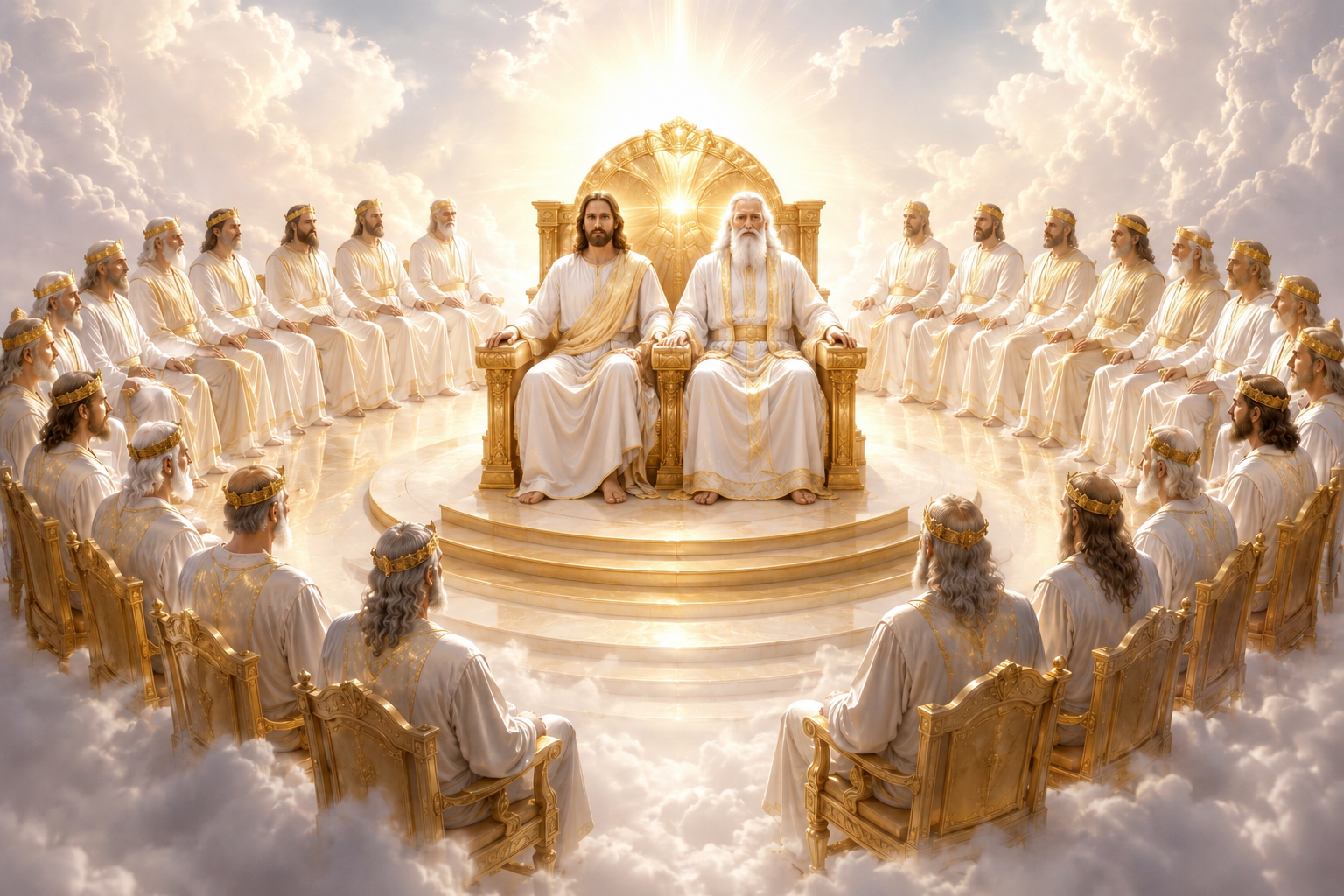
The Divine Council Worldview is a theological framework asserting that the supreme God, Yahweh, governs the universe alongside an assembly of real, created spiritual beings. Popularized by biblical scholar Dr. Michael Heiser in his book The Unseen Realm, this worldview interprets Scripture through the lens of ancient Near Eastern cultures to better understand the supernatural reality recognized by the original biblical writers. [1, 2, 3, 4, 5, 6]
This framework relies on three pivotal cosmic events—the Three Falls—to explain human and spiritual history: [1, 2]
1. The Fall in Eden (Genesis 3)
The first rebellion occurred in Eden. A spiritual being, often identified as the serpent, rebelled against Yahweh by deceiving humanity. This fractured the relationship between humanity, God, and the spiritual realm, introducing sin and death into the world. [1, 2, 3, 4, 5]
2. The Rebellion of the Watchers (Genesis 6)
Before the flood, a group of heavenly beings known as the "Watchers" or "sons of God" crossed spiritual boundaries to mate with human women. This unauthorized union produced a corrupted hybrid race known as the Nephilim. This act filled the earth with violence, resulting in God's judgment through the global flood. [1, 2, 3]
3. The Division of Nations at Babel (Deuteronomy 32)
The foundational anchor of this worldview is the Tower of Babel incident. Following humanity's collective rebellion, God scattered the people, confused their languages, and disinherited the nations. As outlined in Deuteronomy 32:8–9, God assigned these scattered nations to the oversight of lesser spiritual beings ("the sons of God") while keeping Israel as His personal portion. [1, 2, 3, 4, 5]
Key Pillars of the Divine Council Worldview
- The Hierarchy of "Elohim": The Hebrew word Elohim is a place-of-residence term used for any entity residing in the spiritual realm. While Yahweh is an Elohim, He is unique, uncreated, and all-powerful. The other elohim in the council are created, inferior spiritual entities. [1, 2, 3, 4, 5]
- The Rise of Pagan Gods: The spiritual beings assigned to govern the disinherited nations became corrupt. Instead of directing humanity back to Yahweh, they accepted worship for themselves. These rebellious council members became the pagan gods of the ancient world (such as Baal). [1, 2, 3]
- The Judgment of the Council: In Psalm 82:1, God takes His place in the divine assembly to judge these lesser gods for their corrupt administration. He sentences them to "die like men" and strip them of their immortality. [1, 2, 3, 4, 5]
- The New Testament Mission: In the New Testament, this worldview clarifies the mission of Jesus Christ. Through the cross, Jesus defeated these hostile cosmic rulers and authorities. Events like Pentecost and the Great Commission represent Yahweh's systematic reclamation of all disinherited nations back into His kingdom. [1, 2, 3, 4, 5]
Would you like to explore how specific Bible verses like Psalm 82 or Deuteronomy 32 change when read through this perspective?
(B) Explore Psalm 82
Psalm 82 is a central pillar of the Divine Council Worldview. It depicts a courtroom scene where Yahweh judges the corrupt spiritual beings ruling over the pagan nations. [1, 2]
Verse-by-Verse Breakdown
- Verse 1: The Courtroom Setting
"God takes his stand in the divine assembly; he administers judgment in the midst of the gods."- The Visual: Yahweh stands up in the supreme heavenly court.
- The Language: The Hebrew text uses Elohim twice here. It translates literally to: "Elohim [the singular God, Yahweh] takes his stand in the congregation of El; he judges in the midst of the elohim [the plural gods of the council]." [1, 2, 3, 4, 5]
- Verses 2–4: The Indictment
"How long will you judge unjustly and show partiality to the wicked? Defend the cause of the weak and fatherless; maintain the rights of the poor and oppressed." - Verse 5: Cosmic Chaos
"They do not know, they do not understand; they wander about in darkness; all the foundations of the earth are shaken." - Verses 6–7: The Sentence
"I said, ‘You are gods; you are all sons of the Most High.’ But you will die like mere mortals; you will fall like every other ruler.”- The Status: God affirms their supernatural nature. They are real spiritual entities (elohim) and "sons of the Most High" (bney Elyon).
- The Punishment: Because of their rebellion, God strips them of their divine privilege. They are sentenced to lose their immortality and perish like human rulers. [1, 2, 3, 4, 5]
- Verse 8: The Ultimate Hope
"Rise up, O God, judge the earth, for all the nations are your inheritance."
Why This Psalm Matters
- It Rejects Polytheism: The text does not endorse equal pagan gods. Yahweh alone holds supreme authority to judge and sentence the lower council. [1, 2]
- It Rejects the "Human Judges" Theory: Traditional interpretations often claim these "gods" are just corrupt human Israelite kings. However, human kings were never assigned rule over all the nations of the earth, nor does it make sense to sentence a human king to "die like a mortal." [1]
- It Connects to Jesus: In John 10:34, Jesus quotes Verse 6 ("Is it not written in your Law, 'I have said you are gods'") to defend His own divine claim. [1, 2, 3]
If you want to continue tracing this story, we can look at how Deuteronomy 32 sets up the assignment of these gods, or look into Jesus's encounter in John 10. Which direction should we go?
(C) Look at Deuteronomy 32
Deuteronomy 32:8–9 is the literal geographical and geopolitical blueprint of the Divine Council Worldview. Known as the "Deuteronomy 32 Worldview," this passage provides the Old Testament's cosmic explanation for why pagan nations exist and why they worship other gods. [1, 2, 3]
The passage recounts the aftermath of the Tower of Babel incident: [1, 2]
"When the Most High gave the nations their inheritance, when he divided humankind, he fixed the borders of the peoples according to the number of the sons of God. But the Lord's portion is his people, Jacob his allotted heritage." (Deuteronomy 32:8–9, ESV) [1, 2]
1. The Core Cosmic Concept: The Great Disinheritance
According to this worldview, the Tower of Babel was not just a story about languages. It was a massive punitive act of cosmic divorce. [1]
- Humanity's Rebellion: When humanity collectively refused to obey God's command to fill the earth and chose instead to build Babel, God judged them. [1, 2]
- The Judgment: God essentially said, "If you do not want me to be your God, I will assign you to lesser spiritual authorities". He handed the 70 Gentile nations over to the administration of His heavenly assembly. [1, 2]
- The Starting Over: Immediately after Babel, in Genesis 12, God called Abraham out of paganism. Having disinherited the existing nations, Yahweh decided to create a brand-new nation from scratch (Israel) to be His personal portion. [1, 2, 3]
2. The Textual Controversy: "Israel" vs. "Sons of God"
If you open a standard King James or Christian Standard Bible, verse 8 likely reads that God fixed the borders "according to the number of the children of Israel." However, biblical scholars point out that this traditional reading (the Masoretic Text) makes no historical or logical sense. [1, 2, 3, 4]
- The Timeline Problem: Israel did not exist at the time of the Tower of Babel. Jacob (Israel) had not been born, and his 70 descendants had not yet gone to Egypt. [1, 2, 3]
- The Older Manuscripts: The oldest manuscripts we possess—the Dead Sea Scrolls and the ancient Greek Septuagint—read "sons of God" (bene elohim) or "angels of God" instead of Israel.
[1, 2, 3] - The Scriptorium Cover-up: Later scribes who copied the text were uncomfortable with the phrase "sons of God" because they feared it sounded polytheistic. They changed it to "children of Israel" to smooth over the difficulty, unknowingly hiding the cosmic backdrop of the passage. [1, 2]
3. The Parallel Witness: Deuteronomy 4:19–20
The Bible explicitly interprets itself regarding this event just a few chapters earlier. In Deuteronomy 4:19–20, Moses warns Israel not to worship the sun, moon, or stars—the "host of heaven"—which Yahweh has "allotted to all the peoples under the whole heaven." He then contrasts this by saying, "But the Lord has taken you... to be a people of his own inheritance." [1, 2, 3, 4]
The "host of heaven" here does not mean physical balls of gas; it refers to the spiritual entities assigned to govern those nations. [1, 2]
How Deuteronomy 32 Connects to Psalm 82
These two chapters tell a complete narrative arch:
- Deuteronomy 32: God appoints the "sons of God" to rule over the 70 nations at Babel.
- History: These sons of God rebel, abuse the nations, and demand worship for themselves, becoming pagan deities like Baal and Molech.
- Psalm 82: God calls those exact same "sons of God" (bney Elyon) into His courtroom, strips them of their divine positions, and condemns them to die like mortals for their corruption. [1, 2, 3, 4, 5]
Would you like to explore how Jesus's ministry in the New Testament (such as sending out the 70 disciples) directly reacts to this Deuteronomy 32 layout?
(D) Explore Jesus's ministry
Within the Divine Council Worldview, Jesus's ministry was a stealth offensive to reclaim the nations from the corrupt elohim. He did not just come to save individuals; He came to execute a cosmic coup d'état.
The New Testament writers constantly frame Jesus's actions as a direct assault on the territorial strongholds of these rebellious spiritual rulers.
1. The Strategic Geography of Jesus's Ministry
Jesus frequently traveled to specific locations to pick fights with the spiritual powers. [1]
- The Gates of Hell (Caesarea Philippi): In Matthew 16, Jesus takes His disciples to Caesarea Philippi, located at the base of Mount Hermon. In the ancient world, this was the epicenter of pagan worship (dedicated to Pan) and, according to ancient Jewish tradition (Book of Enoch), the exact site where the Watchers descended to rebel in Genesis 6.
- The Gerasene Demoniac: When Jesus crosses the Sea of Galilee into the region of the Gerasenes (Mark 5), He enters official Gentile territory—land assigned to the corrupt gods. The demoniac He meets is possessed by a "Legion" of spirits who beg Jesus not to cast them out of the region. They recognized Jesus's intrusion as an illegal invasion of their allocated territory. [1, 2]
2. The Sending of the 70 (The Counter-Attack at Babel)
In Luke 10, Jesus does something highly symbolic: He appoints and sends out 70 disciples ahead of Him. [1, 2, 3]
- The Connection: In Genesis 10 (the Table of Nations right before Babel), there are exactly 70 Gentile nations listed. [1, 2]
- The Meaning: By sending out exactly 70 disciples, Jesus was signaling the imminent reclamation of the 70 disinherited nations of Deuteronomy 32.
[1, 2] - The Result: When the 70 return celebrating their authority over demons, Jesus responds: "I saw Satan fall like lightning from heaven." The institutional grip of the cosmic rulers was beginning to shatter. [1, 2, 3]
3. The Transfiguration: Reclaiming Mount Hermon
Immediately after declaring war at Caesarea Philippi, Jesus takes Peter, James, and John up a "high mountain" (historically identified as Mount Hermon). [1]
- The Cosmic Statement: Jesus peels back His flesh and reveals His blinding, uncreated glory.
- The Message: On the very mountain where the Watchers plotted their rebellion, Jesus plants His flag. He visually demonstrates to the spiritual realm that He is the supreme, rightful ruler of heaven and earth. [1]
4. The Crucifixion as a Divine "Trojan Horse"
The ultimate victory over the divine council occurred at the cross, achieved through brilliant spiritual misdirection.
- The Blindspot: Paul writes in 1 Corinthians 2:8 that "None of the rulers of this age understood this, for if they had, they would not have crucified the Lord of glory." The "rulers of this age" is Paul’s technical term for the territorial cosmic powers. [1]
- The Trap: The corrupt gods thought that killing Jesus would secure their thrones. Instead, it legalistically sealed their doom.
- The Disarming: Colossians 2:15 states that by dying on the cross, Jesus "disarmed the rulers and authorities and put them to open shame, by triumphing over them." By paying the penalty for human sin, Jesus broke the legal right these gods had to hold humanity in spiritual captivity.
The Ultimate Climax: The Great Commission
After His resurrection, Jesus gathers His disciples and states: "All authority in heaven and on earth has been given to me. Go therefore and make disciples of all nations..." (Matthew 28:18–19). [1, 2, 3, 4, 5]
Because Jesus stripped the rebel gods of their authority, the boundaries of Deuteronomy 32 are officially dissolved. The gospel is the systematic invasion and reclamation of the entire global territory back into the Kingdom of God.If you want to see how this plays out after Jesus, we can look at Pentecost as the reversal of Babel, or explore Paul's vocabulary for these cosmic powers ("Principalities and Powers"). Where should we go next? [1]
(E) Look at Pentecost
In the Divine Council Worldview, Pentecost (Acts 2) is not just the birthday of the Church. It is the definitive, legal reversal of the Tower of Babel. [1, 2]
At Babel, God scattered the nations, confused their languages, and abandoned them to lesser spiritual rulers. At Pentecost, God launched His global reclamation project to bring those same nations back under His direct sovereignty. [1, 2, 3, 4, 5]
1. The Undoing of the Language Curse
At Babel, language was weaponized to divide humanity and cut them off from Yahweh. [1, 2]
- The Babel Contrast: In Genesis 11, human speech became confused, causing division and scattering.
- The Pentecost Reversal: In Acts 2:4, the Holy Spirit fills the disciples, and they begin to speak in other tongues.
- The Miracle: Thousands of visitors from across the ancient world hear the wonders of God being proclaimed in their own native dialects. God used supernatural speech not to confuse, but to gather and unite the scattered nations. [1, 2, 3, 4, 5]
2. The Geopolitical Audience (The Table of Nations Re-visited)
Luke’s meticulous list of locations in Acts 2:9–11 ("Parthians, Medes, Elamites, residents of Mesopotamia...") is not random background information. It is a precise geographical map matching the 70 disinherited Gentile nations of Genesis 10. [1, 2, 3, 4]
- The Setup: Jews living in exile across all these specific Gentile territories had traveled back to Jerusalem for the Feast of Pentecost. [1]
- The Impact: These individuals represented the exact territories that God had handed over to the corrupt elohim in Deuteronomy 32.
- The Dispersion: When these visitors accepted the Gospel, they immediately carried the message back to their respective countries. The invasion of the dark spiritual territories did not start with an army, but with converts returning home to preach the dethronement of their regional gods. [1]
3. The Visual Symbols of Cosmic Takeover
The supernatural manifestations at Pentecost are direct visual cues pointing back to ancient expressions of divine governance. [1, 2]
- The Mighty Rushing Wind: In the Old Testament, a violent wind or tempest always accompanies the presence of Yahweh's heavenly chariot-throne (such as in Ezekiel 1). It signals that the Supreme King has arrived on the scene to do business. [1]
- The Divided Tongues of Fire: Acts 2:3 notes that "divided tongues as of fire appeared to them and rested on each one of them."
- In the ancient Greek Septuagint translation of Deuteronomy 32:8, it says God divided the nations "according to the angels of God."
- By sending divided tongues of fire onto individual humans, God was showing that the Holy Spirit was replacing the corrupt cosmic rulers. Instead of nations being ruled by lesser spiritual beings, individual believers were now being made the direct temples of the living God. [1, 2, 3, 4]
The Cosmic Result: A Global Family
Through Pentecost, God signaled to the planetary rulers that their legal monopoly over the Gentile world was broken. The Gospel was no longer restricted to the borders of Israel. Anyone from any disinherited nation could now be adopted into the divine family of Yahweh. [1, 2]
If you want to finish this cosmic storyline, we can look at Paul’s warfare terminology ("Principalities and Powers") to see how the early church fought this ongoing spiritual battle, or we can look at the final destiny of these gods in the Book of Revelation. What interests you most?
(F) Look at Paul's warfare terminology
The Apostle Paul did not invent his vocabulary for spiritual warfare from scratch. In the Divine Council Worldview, Paul’s letters use precise, technical Greek terminology to map out the hierarchy of the rebellious elohim that God disinherited at Babel.
When Paul writes about spiritual warfare, he is describing a structural, geopolitical coup against cosmic entities that hold territories and nations in bondage.
1. The Cosmic Hierarchy (Ephesians 6:12)
In his most famous passage on spiritual warfare, Paul explicitly defines the enemy, using a highly organized chain of command: [1, 2]
"For we do not wrestle against flesh and blood, but against the rulers (archas), against the authorities (exousias), against the cosmic powers over this present darkness (kosmokratoras), against the spiritual forces of evil in the heavenly places."
- Rulers (Archas): These are the top-tier, primary governing cosmic entities. They are the principalities assigned to oversee specific geopolitical regions and nations. [1, 2, 3, 4]
- Authorities (Exousias): Operational spiritual powers holding delegated legal rights to dominate and manipulate human structures, cultures, and governments. [1, 2, 3]
- Cosmic Powers (Kosmokratoras): A unique Greek word meaning "world-rulers." It highlights their comprehensive, planetary grip on the pagan world before Christ shattered their monopoly. [1, 2, 3]
- Spiritual Forces (Pneumatika): The generalized cosmic rank-and-file entities operating from the spiritual realm ("heavenly places") to spread chaos and deception. [1, 2, 3]
2. The Elemental Spirits (Stoicheia)
In Galatians 4:3 and Colossians 2:20, Paul warns believers against falling back into bondage under the "elemental spirits of the world" (stoicheia tou kosmou). [1, 2]
- The Traditional View: Many modern commentators translate this simply as "basic principles" or "ABC principles" of religion.
- The Divine Council View: In the ancient world, stoicheia referred to the spirit beings associated with stars, signs, and physical elements. Paul uses it to describe the personal, hostile cosmic powers that regulated human life under paganism through superstitious laws, astrology, and false religion. [1, 2, 3, 4]
3. The "God of this World" (2 Corinthians 4:4)
Paul refers to Satan as the "god of this world" (theos tou aionos toutou), who has blinded the minds of unbelievers. [1, 2, 3, 4]
- The Status: Paul acknowledges that within the current corrupted cosmic order, Satan functions as an elohim (god) to the rebellious world system.
- The Function: His primary job is information warfare—blocking the light of the gospel from penetrating the dark spiritual territories so that nations remain trapped under the council's rule.
The Nature of Paul's Warfare: Decolonizing the Mind
Because Jesus already legally disarmed these powers at the cross, Paul's view of spiritual warfare is fundamentally different from modern pop-culture ideas. [1]
- No Spits and Screams: Paul never tells believers to engage in shouting matches with territorial demons or physically march into cities to cast out regional spirits.
- Mind and Culture: In 2 Corinthians 10:4–5, Paul defines the true weapons of warfare: "We destroy arguments and every lofty opinion raised against the knowledge of God, and take every thought captive to obey Christ." [1, 2, 3, 4, 5]
- The Strategy: The "strongholds" are ideological. Spiritual warfare is an intellectual and spiritual decolonization project. It is fought by preaching the truth, practicing justice, and living out the reality of Jesus's victory, which automatically starves the local cosmic rulers of their influence and power. [1, 2, 3]
To bring this entire biblical narrative to its conclusion, we can look at the final destiny of these gods in the Book of Revelation, or look at how believers are meant to eventually replace these entities. Which would you like to explore?
(G) Look at the final destiny of these gods
In the Divine Council Worldview, the story of the cosmos does not end with a vague spiritual afterlife. It ends with a legal eviction notice. The final destiny of the corrupt elohim is a systematic demotion, trial, and execution, followed by a total replacement of the heavenly council by human believers.
The Book of Revelation maps out this cosmic eviction in three distinct phases:
1. The Eviction from the Courtroom (Revelation 12)
Before the rebel gods are destroyed, they are stripped of their legal access to the heavenly courts.
- The Cosmic War: Revelation 12:7–9 describes a war in heaven where Michael and his angels fight against the dragon (Satan) and his angels. [1, 2, 3]
- The Verdict: The dragon and his spiritual allies lose their place in heaven and are thrown down to the earth. [1, 2]
- The Legal Reason: Why now? Verse 10 explains that the "accuser of our brothers" has been thrown down. Because of Jesus's resurrection and ascension, these gods no longer have any legal right to stand before Yahweh's throne and demand the condemnation of humanity. Their cosmic security clearance is permanently revoked.
[1, 2]
2. The Execution of the Sentence (Revelation 19–20)
This phase is the direct fulfillment of the prophecy in Psalm 82:7, where God warned the corrupt gods: "You will die like mere mortals; you will fall like every other ruler." [1, 2, 3]
- The Round-Up: In Revelation 19 and 20, as Jesus returns to fully establish His kingdom on earth, the hostile spiritual powers are rounded up. [1]
- The Lake of Fire: The ultimate destination for the Beast, the False Prophet, the Dragon, and Death and Hades is the Lake of Fire (Revelation 20:10, 14). [1, 2, 3]
- The "Second Death": The Lake of Fire was explicitly created for the devil and his angels (Matthew 25:41). It is where these immortal spiritual entities undergo the "Second Death"—a state of total, permanent incapacitation, destruction, and eternal torment. They are effectively stripped of their divinity and reduced to nothing. [1, 2, 3, 4, 5]
3. The Divine Council 2.0 (The Ultimate Replacement)
The most striking aspect of the final destiny of these gods is who takes their place. God does not leave the seats of the Divine Council empty. He populates them with glorified human beings. [1, 2]
- Judging Angels: Paul writes a shocking statement to the believers in 1 Corinthians 6:3: "Do you not know that we will judge angels?" In the ancient world, to "judge" often meant to rule or govern. Humanity is destined to sit in judgment over the very spiritual rulers that once oppressed them. [1, 2, 3, 4]
- The Morning Star: In Revelation 2:26–28, Jesus promises the overcomer: "I will give authority over the nations... just as I have received authority from my Father. And I will give him the morning star." In the ancient Near East, the "morning star" was a title for a divine, ruling spiritual being. Jesus is promising that human believers will inherit the ruling titles and cosmic thrones vacated by the fallen elohim. [1, 2, 3, 4, 5]
- Ruling and Reigning: The book ends in Revelation 22:5 with the ultimate destiny of humanity: "And they will reign forever and ever." [1, 2, 3]
The Full Circle
The overarching narrative of the Bible is a complete circle. Humanity was created in Eden to partner with God as His earthly council. When humanity fell, and the spiritual council rebelled at Babel, God disinherited the earth. [1, 2, 3, 4, 5]
Through Christ, the corrupt spiritual rulers are thrown down and destroyed, and humanity is elevated—not just back to Eden, but into the heavy-duty governing seats of the heavenly assembly. [1]
To wrap up our discussion on the Divine Council Worldview, I can provide a summary of the core books and scholars (like Michael Heiser) who developed this framework, or we can look at the common criticisms theologians have against it. Where would you like to conclude? [1]
(H) Provide a summary of the core books
The Divine Council Worldview was brought into the mainstream primarily through the work of the late biblical scholar Dr. Michael S. Heiser. To dig deeper into this framework, it helps to look at the specific books he wrote, which are tailored to different audiences and depth levels.
Here is a summary of the core books that define and explore this worldview:
1. The Unseen Realm: Recovering the Supernatural Worldview of the Bible (2015)
- The Target: Academics, pastors, and serious students of the Bible.
- The Core Focus: This is the flagship textbook of the Divine Council Worldview. Dr. Heiser meticulously walks through the Old and New Testaments chronologically, using ancient Near Eastern texts and dead sea scrolls to prove his points.
- Key Takeaway: It challenges modern readers to take the supernatural text seriously, demonstrating how the "Three Falls" shape the entire biblical narrative from Genesis to Revelation.
2. Supernatural: What the Bible Teaches About the Unseen World - And Why It Matters (2015)
- The Target: Laypeople, small groups, and casual readers.
- The Core Focus: Released alongside The Unseen Realm, this is a distilled, condensed, and highly practical version of the larger textbook. It strips away the heavy Hebrew transliterations and academic footnotes.
- Key Takeaway: It focuses heavily on the application: how knowing about the Divine Council changes how an everyday Christian reads their Bible, prays, and views their purpose in the local church.
3. Reversing Hermon: Enoch, the Watchers, and the Forgotten Cosmic Context of the Bible (2017)
- The Target: Readers looking for deep dive into the weirdest parts of Scripture.
- The Core Focus: This book focuses specifically on the Second Fall (Genesis 6) and the Second Temple period literature—specifically the Book of 1 Enoch. Heiser argues that the New Testament writers were heavily influenced by Enoch's retelling of the Watcher rebellion.
- Key Takeaway: It explains how heavily Jesus's ministry and the Apostle Peter’s letters were designed to directly mock and undo the rebellion of the Watchers at Mount Hermon.
4. Angels: What the Bible Really Says About God’s Heavenly Host (2018)
- The Target: Believers looking to separate biblical fact from cultural myth.
- The Core Focus: A targeted theological study on the loyal members of the Divine Council. Heiser deconstructs popular pop-culture myths about angels (like them having wings, halos, or being genderless) and looks at their specific jobs, ranks, and roles in God's cosmic bureaucracy.
5. Demons: What the Bible Really Says About the Powers of Darkness (2020)
- The Target: Believers looking to understand dark spiritual warfare.
- The Core Focus: The companion book to Angels, this tackles the rebellious entities of the council. It clearly categorizes the difference between the Old Testament elohim (pagan gods), the localized territorial spirits, the disembodied spirits of the Nephilim (demons), and Satan himself.
If you'd like to explore how this worldview is received by the wider theological community, I can walk you through the common criticisms and pushbacks it receives from mainstream scholars. Would you find that helpful?
(I) Walk through the criticisms and pushback
While the Divine Council Worldview has gained massive popularity among laypeople and many pastors, it faces distinct pushback from various corners of the theological world. Critics range from traditional systematic theologians to historical-critical scholars.
The primary criticisms and pushbacks leveled against this framework include the following:
1. The Threat of "Soft Polytheism" or Monolatry
The most common pushback from traditional, conservative theologians is that the framework flirts too closely with polytheism or monolatry (the worship of one God while accepting the existence of others).
- The Criticism: Traditional Christianity has long asserted strict monotheism—that only one true God exists, and all pagan "gods" are completely imaginary or merely psychological delusions.
- The Concern: By defining elohim as a real, distinct plural category of spiritual beings who possess genuine cosmic authority, critics argue that the Divine Council worldview unintentionally weakens the unique ontological status of Yahweh, making Him look more like the "chief god" of a pantheon rather than the only existing God.
2. Over-Reliance on Non-Biblical Texts (Like 1 Enoch)
Scholars frequently question the heavy weight given to Second Temple Jewish literature—specifically the pseudepigraphal Book of 1 Enoch—to interpret canonical Scripture.
- The Criticism: Dr. Heiser uses 1 Enoch extensively to decode Genesis 6 and the New Testament's view of Peter, Jude, and Jesus's ministry.
- The Pushback: Mainstream scholars argue that while 1 Enoch is highly useful for historical context, it is not inspired Scripture. Giving a non-canonical, apocalyptic text the power to dictate the primary meaning of the canonical Old Testament is seen by critics as a hermeneutical overreach that violates the principle of Sola Scriptura (Scripture alone).
3. Exegetical "Over-Reading" and Parallelomania
"Parallelomania" is a scholarly term for the tendency to see historical or cultural parallels everywhere, even where they might not exist. [1]
- The Criticism: Critics argue that the Divine Council worldview forces every single verse into a cosmic, supernatural warfare template.
- The Pushback: For instance, when Paul talks about "rulers and authorities," many standard commentators argue he is often referring to human political rulers (like the Roman Empire) or abstract systemic evils. Critics charge that Heiser "over-reads" these passages by automatically assigning a literal, geographic, territorial space-demon to every mention of power.
4. Overcomplicating Simple Historical Narratives
Old Testament historians push back on the idea that the Tower of Babel was an intentional "cosmic divorce" involving a calculated handoff to 70 specific spiritual entities.
- The Criticism: They argue that Genesis 11 is structurally a localized, historical etiology meant to explain the origin of human languages and the dispersal of early civilizations, nothing more.
- The Pushback: By elevating the textual variance in Deuteronomy 32 ("sons of God" vs. "sons of Israel") into a grand cosmic conspiracy, critics argue the framework turns a straightforward historical judgment into a convoluted supernatural drama.
5. Neglect of Human Agency and Systematic Theology
Traditional systematic theologians often feel the Divine Council worldview inadvertently shifts the blame for human evil away from human hearts and onto external spiritual forces.
- The Criticism: The Bible places an overwhelming emphasis on human sin, repentance, and personal moral responsibility.
- The Pushback: If the nations are wicked primarily because they are being dominated and blinded by corrupt cosmic elohim, it can subtly diminish human accountability. Critics argue the framework over-emphasizes deliverance from cosmic powers at the expense of traditional theological focuses like justification, sanctification, and the internal battle against human flesh. [1]
If you'd like, we can conclude our deep dive here, or I can help you with a few other aspects. Let me know if you would like to:
- Look at a side-by-side comparison of how a specific passage (like Genesis 6) is interpreted traditionally versus through the Divine Council lens.
- Explore how this worldview impacts a believer's daily view of prayer and spiritual warfare.