Understanding the Deity or Godhead : from Scripture and Nature
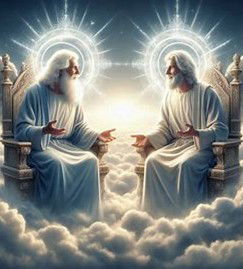
Forms, forms, everywhere
From the moment I opened my eyes after birth, I see people and things. I see objects, I see my parents. I see light and hear sounds coming from objects and beings. So, whenever I see brightness, I know there is a source producing it and where it came from. And whenever I hear a sound, I also know there is a source producing it and where it came from. If I see a shadow in front of me, I know there must be a light source somewhere behind me. This common knowledge has not changed for me ever since I grew up. It’s the same experience for me and for every other human being, in so far as I can see.
Whenever I see plumes of smoke, I know there is a source for them. There is no smoke without fire. Whenever I see hazy steam or shapeless vapour, I also know there is a source for it. And all, these almost invisible “formless” stuffs have a source and the source has an origin in a form. There is form or shapes everywhere in nature.
In this so-called imperfect world, all the forms that I see clearly around me are real. They all can be felt by my senses, and so are as real as can be to me. They are the true nature of reality, though they be “impermanent” (not lasting forever). This reality abides in my thinking ever since my birth, becoming real knowledge. On this basis, science has developed and flourished. There are living forms and static forms. Both of these categories are not mere appearances. They are as permanent or as stable as their own life-spans can be. And this stability keeps repeating itself – birth, stability for a lifetime, decay, death, and the cycle begins again – if only to emphasize this reality for every person in every generation to experience. I don’t see myself as a mere fleeting appearance, or a dream, denying the reality that I have been living in for so long. Does anyone else see himself genuinely as real or truly as a mere appearance?
Nevertheless, everyone recognizes the imperfections of this world in which he lives, and desire an attainment of perfection. What is perfection? Each philosophy has its own view of this. Early Greek philosopher Plato thought of the concept of perfect, unchanging, eternal Forms such as Goodness, Beauty, Justice, Truth in their “purest form” – all are abstractions. To Plato (and others who share his thoughts), contemplating these Forms through reason and intellect, one can gain a deeper understanding of reality and attain true knowledge. Can imperfect man contemplating on his own ideas of perfection and working on them, necessarily imperfectly, “attain” perfection without external input to transform his imperfect nature? Could this just be an abstract perfection? What is this like? Would we know only after having attained it?
Rather, would it not be better or more logical to think of an ideal Being, not anyone in this admittedly imperfect world, but from an actual Perfect Realm, who came to teach us and impart to us a kind of transformative essence to help perfect us? Was there such a one who came into history, expressly declaring himself as from this Realm, showing the way, and demonstrated it impactfully with undeniable miraculous power? There was. And there is an expanding acknowledgement of this – in the historical person of Jesus Christ.
Reality, concepts and God
When I had a nightmare, my parents assured me it was not real, not to worry about it. It was just a bad dream. There were happy dreams, but they were also not real. Likewise, imaginations or ideas are abstract thoughts, not real substances though these abstract thoughts are produced in the mind or a set of structural substances (neurons) in the brain. What is real is confirmed by my reliable five senses, that is: sight, hearing, smell, touch, taste – which everyone is endowed with in common.
Then I learnt alphabets and words – to understand what was spoken and written and in turn for me to convey what I speak and write. “The alphabet is a standardized set of letters that correspond to specific sounds in a language. This phonemic representation allows for the accurate transcription of spoken language into written form, making it possible to communicate ideas and information effectively. By providing a means to record speech and written communication, alphabets help maintain cultural heritage across generations. This is particularly important for documenting history, literature and traditions... it is foundational in education.” (Copilot answer)
Then there was the concept of God. There is a general intuition of mankind that there is a God, a most mighty being, who is good and just, and who has a form, existing somewhere in heaven or space. When I was in primary school, my parents told me that God was “three persons in one body.” Obviously, at that age, I didn’t understand this concept. It was not until much later when I began to review all that I have been taught, that I came to understand the Godhead, one that makes sense to me after studying Scripture for myself and reflecting on nature (God’s creation).
I became aware of a huge controversy, Trinitarian-Arian controversy of the fourth century (with involvement of much religious and political intrigues) that lasted an unbelievably long sixty years of tussle before church councils finally settled on the current form of Trinitarian concept, yet Arianism or a variation of it is adhered to by groups of fervent believers outside of the mainstream to this day.
Here, I lay out my studies and reflections. As described in chapter 1 of my book, on “First principles and God”, my journey took me to the primary conclusion that “in the utmost beginning, there was Space, God and Time” – the primal “trinity” so to speak. Time and space do not begin with the origin of matter, contrary to “scientific” assumptions. Time and Space exist alongside a singular God before the universe began.
How am I to understand this God? He is the Supreme Being, eternally self-existing, composed of spirit substance (in contrast to material substance) and He looks like a human in outward form or shape or image, just like the image of a kingly figurehead imprinted on a coin (Luke 20:24) and also having an internal likeness similar to all the human senses and consciousness. The Bible tells us that we are made in the image and likeness of God (Gen 1:26). There is structure in the composition of material being, man; there is similarly a structure in the composition of the spirit being, God; there’s a parallel likeness between them, ontologically. This settles the basic idea in my mind. God is not some hazy stuff out there in Space, not an abstraction of human thought or a figment of collective human imagination. God is embodied, just like a human is. God is as fully ontological as man is. Both exist somewhere in Space. And both are complex beings, with God being much more powerful and complex. There is little controversy here for me.
The controversy in biblical history arises in trying to understand Jesus Christ and his claims (often subtle or held-back in his early sojourn) or his apostles’ claims about him, when he walked in history and his relationship to the Old Testament God or Gods such as El, Elohim, El Elyon (Most High God), El Shaddai, Yahweh (YHWH), Adonai and others. There appears to be uncertainties about who exactly these entities are in the Old Testament narrative. How is Jesus related to these entities? Who exactly is this man Jesus who has such an undeniable impact in history and in religious thought?
I follow these guidelines in my study:
- Placing clear scriptures above unclear ones
- Placing greater emphasis on letting New Testament scriptures explain Old Testament ones
- Premising on clearer later revelations from Jesus Christ and his apostles (as recorded in the four Gospels), especially John (his beloved apostle, who was given much revelation) and also the apostle Paul (who was taught by the ascended Jesus Christ himself from heaven in the Arabian dessert)
Who is Jesus Christ?
(from Colossians 1:15 and Hebrews 1:3, the most definitive scriptures)
Who is the image of the invisible God, the firstborn of every creature – Col 1:15 King James Version
who is the image of the invisible God, the firstborn over all creation – Col 1:15 International Standard Version
Who is the image of the unseen God, the firstborn of all creation – Col 1:15 Literal Emphasis Translation
Image = G1504, eikōn, a likeness, that is, (literally) statue, profile, or (figuratively) representation, resemblance: - image.
Firstborn = G4416, pro-tot-ok'-os, from G4413 and the alternate of G5088; first born (usually as noun, literally or figuratively): - firstbegotten (-born).
Who being the brightness of his glory, and the express image of his person… – Heb 1:3a KJV
who being the brightness of the glory, and the impress of His subsistence… – Heb 1:3a Literal Standard Version
He is the reflection [Or radiance] of God’s glory and the exact likeness of his being… – Heb 1:3a ISV
Brightness/radiance = G541, apaugasma, from a compound of G575 and G826; an off flash, that is, effulgence: - brightness.
Express image/impress/exact likeness = G5481, charaktēr, from the same as G5482; a graver (the tool or the person), that is, (by implication) engraving ([“character”], the figure stamped, that is, an exact copy or [figuratively] representation): - express image.
From the above verses (taken from four sample translations), it is seen that
- Jesus Christ is the visible and exact image(eikōn [statue-like image, profile], and charaktēr, exact copy)of the invisible God. There is no denying in these clear verses that both the Son and the Father look exactly alike, one being visible to human eye and the other not visible to physical human eye (not as yet, at this present time), and
- Jesus Christ is the firstborn or firstbegotten (G4416 = prōtotokos, From G4413 and the alternate of G5088; first born (usually as noun, literally or figuratively): - firstbegotten (-born) of all creation/every creature.
Jesus Christ, not humans, has seen the invisible God (Father) – John 1:18, 5:37, 6:46, 14:7
No man hath seen God at any time; the only begotten Son, which is in the bosom of the Father, he hath declared* him – John 1:18 KJV
No one has ever seen God; the only begotten God who is on the bosom of the Father—He has expounded* Him – John 1:18 LSV
No one, hath seen, God, at any time: An Only Begotten God, The One existing within the bosom of the Father, He, hath interpreted* him – John 1:18 Rotherham
(*G1834 exēgeomai, From G1537 and G2233; to consider out (aloud), that is, rehearse, unfold: - declare, tell.)
And the Father himself, which hath sent me, hath borne witness of me. Ye have neither heard his voice at any time, nor seen his shape. – John 5:37 KJV
Not that any man hath seen the Father, save he which is of God, he hath seen the Father. – John 6:46 KJV
If ye had known me, ye should have known my Father also: and from henceforth ye know him, and have seen him. – John 14:7 KJV
Jesus says to him, “Such a long time am I with you, and you have not known Me, Philip? He who has seen Me has seen the Father; and how do you say, Show to us the Father? (John 14:9 LSV)
In other words, from Jesus’ appearance on earth, all his disciples who have seen, heard and touched Jesus are as good as having seen God, because Jesus looks like God and is the image and exact representation of God (connecting the above verses), though in lesser glory when he was on earth, having then taken on the form of a servant.
In Matthew 18:10 LSV, Jesus told the disciples that the “messengers in the heavens always behold the face of My Father who is in the heavens.” The invisible messengers of heaven can see the invisible Father there.
“Our Father who art in heaven,” declares Jesus Christ, as recorded no less than 18 times in the Gospels. The God and Father of Jesus Christ is a separate individual residing somewhere in heaven, an area in Space, but not everywhere.
Firstborn of creation
From Colossians 1:15 quoted above, Jesus Christ is the firstborn of all creation. He is the firstborn of the Father, by holy spirit generation, not creation. That is, Father God gave birth to the Son God. Just like every human birth that came by generation from human parents. Father God gave birth directly to the Son God by parthenogenesis (asexual reproduction, a process that can be seen in many instances in nature, like an amoeba splitting itself into two, giving rise to a double or a son amoeba – or a clone amoeba). God’s eternal power and divinity can be clearly seen in His creation (Romans 1:20). We can draw lessons from it in understanding the Godhead.
Thus, we see that the eternal God at some point in eternity past decided to have a companion and a family. This supreme God, first time in the history of Space, begat another One, who naturally inherits all that God was, is or has. This begotten One therefore is of God’s kind, God’s DNA being in him. He is then the Second God. There were two Gods before anything else came into existence. But virtue of the Second God being born, he became the Son and God became the Father. This second God became known as the begotten God or the begotten Son, both terms being an accurate presentation of scriptural revelation (See John 1:18 in different translations). The Greek word for begotten is monogenes, which means “single of its kind” or “unique”. So, Jesus is a unique Son or unique God.
The Father-Son relationship automatically arise by definition (in normal parlance) from the point of existence of this second God by generation. This was the first divine family unit. Like any good parent, the Father loves the Son dearly, as expressed in many scriptures, quoted below:
- (Mat 12:18) Behold, My Servant, whom I chose, My Beloved, in whom My soul delighted.
- (Mat 3:17) and behold, a voice out of the heavens, saying, This is My Son, the Beloved, in whom I delighted.
- (Mat 17:5) While he is yet speaking, behold, a bright cloud overshadowed them, and behold, a voice out of the cloud, saying, This is My Son, the Beloved, in whom I delighted; hear Him.
- (Mark 1:11) and a voice came out of the heavens, You are My Son, the Beloved, in whom I delighted.
- (Mark 9:7) And there came a cloud overshadowing them, and there came a voice out of the cloud, saying, This is My Son, the Beloved, hear Him.
- (Luke 3:22) and the Holy Spirit came down in a bodily appearance, as if a dove, on Him, and a voice came out of Heaven, saying, You are My Son, the Beloved, in You I delighted.
- (Luke 9:35) and a voice came out of the cloud, saying, This is My Son, the Beloved; hear Him.
- (John 17:24) Father, those whom You have given to Me, I will that where I am they also may be with Me, that they may behold My glory that You gave to Me, because You loved Me before the foundation of the world. (Note this crucial verse)
- (John 17:26) and I made known to them Your Name, and will make known, that the love with which You l oved Me may be in them, and I in them.
- (Col 1:13) who rescued us out of the authority of the darkness, and translated us into the kingdom of the Son of His love.
- (2Pet 1:17) for having received honour and glory from God the Father, such a voice being borne to Him by the Excellent Glory: This is My Son, the Beloved, in whom I delighted.
Two Gods: the eternal unbegotten God (the Father) and the begotten God (the Son) who has a beginning.
¶ but concerning the Son, “Your throne, O God, is forever and ever [Literally “for the age of the age”], and the scepter of righteous is the scepter of your kingdom. You have loved righteousness and hated lawlessness; because of this God, your God, has anointed you with the olive oil of joy more than your companions. [A quotation from Ps 45:6–7] (Heb 1:8-9 LEB)
In the above verses, we see God (the Father) addressing the Son as “God” (verse 8) and He (the Father) is also "God" to the Son himself (verse 9). The Father and the Son are both Gods (of the Godkind).
The apostle Paul frequently uses the phrase "God and father of our Lord Jesus Christ" in numerous instances in his epistles.
There is God the Father and God the Son and they are not co-equal in status. This fact of Scripture does not diminish reverence for the Son a wee bit, as some might fear.
Is it any wonder that Jesus Christ says
- my Father is greater than I? (John 14:28 LSV);
- truly, truly, I say to you, a servant is not greater than his lord, nor an apostle greater than he who sent him. Jesus tells us “I came forth from God” (John 16:27 LSV);
- I came forth from the Father, and am come into the world (John 16:28 KJV);
- … for I proceeded forth and came from God; neither came I of myself, but he sent me. (John 8:42 KJV)
- because I have come down out of Heaven, not that I may do My will, but the will of Him who sent Me. (John 6:38 LSV)
- Jesus asks: What if you shall see the Son of man ascend up where he was before? (John 6"38)
- He who is coming from above is above all.. (John 3:31 LSV)
- Jesus knowing that all things the Father has given to Him—into His hands, and that He came forth from God, and He goes to God, (John 13:3 LSV)
Father, Son, Holy Spirit
The two Gods (the Father and the Son) enjoyed their intimate family relationship in spirit, in oneness, for an unknown period of time – before the creation of the universe. There must be deep bonding between them during that time. The Father was in the Son and the Son in the Father (John 14:11). “Believe me that I am in the Father, and the Father in me” says Jesus. How can two persons be in each other? The simple answer must be the powerful internal life "personality essence" of the Father which was imparted to the Son on begettal – the same life essence infusing both of them and energizing them in what they are: spiritual God nature. Because the Son was begotten of the Father, he inherits ontologically all the internal spiritual life essence and glory of the Father in him – the Holy Spirit – which is not a third person, contrary to popular belief. They both have the same “substance” – same spiritual substance or essence – same Holy Spirit abiding within them – which can emanate from them and be imparted in measure to believers. The Father is a tripartite composite of form (or shape) and Holy Spirit life essence and soul (bodily consciousness); likewise the Son is also exactly constituted (Heb 1:3) – of a tripartite composition, closely knitted. The fullness or completeness of the Deity inhabits or indwells the Son bodily (Col 1:19, Col 2:9, Php 2:6). The Son, an individual being inherently in the bodily form of God (Heb 1:3) is as divine as the other individual Father God. Like Father like Son.
Scripture tells us that: God has a soul (Matt 12:18), Jesus has a soul (John 12:27), God and man have a soul (Zech 11:8), Adam was a living soul (Gen 2:7). A study of the word "soul" in the Scripture shows that it is equivalent to the modern term of "consciousness” which incorporates a “qualia-sensation-awareness" complex.
I can relate to Jesus’ words in John 14:11 by comparing myself with my biological father (or mother) – who has exactly the same human spirit and soul (consciousness, qualia, sensation, awareness) infusing him even as I have all these infusing my own person. His make-up is exactly the same as my make-up: a tripartite nature (body, soul, spirit). He is in me and I am in him, in a parallel manner of speaking – ontologically speaking – in terms of this whole human being, in natural revelation. (Romans 1:20)
The Word in the Beginning
In the beginning was the Word, and the Word was with@ God, and the Word was God; this One was in the beginning with@ God – John 1:1-2 LSV
@(G4314 = pros, a preposition of direction; forward to, that is, toward..)
In the beginning was the word, and the word was toward theGod, and God was the word. This was in the beginning toward theGod. – John 1:1-2 Concordant Literal Version
(The Word is Logos in Greek (G3056). From G3004; something said (including the thought); by implication a topic (subject of discourse), also reasoning (the mental faculty) or motive; by extension a computation; specifically (with the article in John) the Divine Expression (that is, Christ)
When we all think of the Supreme God (the Father God), we think of Him as without a beginning, by default thought, by presupposition. He was always existing. As this is presupposed by everyone, it would be superfluous to speak of any beginning with Him. He has no beginning. The earliest thought of “beginning” mentioned in the Bible would therefore refer to the point when the Son came into being (was birthed into existence). The next thought of “beginning” would be referring to the next great event, that is, the beginning of the creation of the universe (Genesis 1:1). There are many more times the word “beginning” is used in the bible, each referring to the beginning of some other specific things spoken of in its context.
Here in John 1:1, the Word (Logos) apparently refers to John’s initial introduction of prime revelation of the Son; the conveyance of thoughts progressively as in learning a language that we are all familiar with, through the (almost universal) sequence of learning, first with the basic alphabets, then letters, words, names, sentences, grammar, stories, precepts, concepts, teachings, message, and so on. The Word presupposes itself as coming from the mind of a Speaker or Teacher or Revelator, not an abstraction hanging in space. And John is introducing this Revelator, the Son of God, Jesus Christ. And the Word (spoken and written) progressively became vivid and came to life. This is the subject of his gospel.
Notice the steps of John’s presentation:
This revelatory Word was with God and towards (points to) God. (John 1:1-2 CLV). The Greek pros (towards) was used twice in these two verses for emphasis. Two translations for each verse are quoted below side by side for comparison.
- All came~into being through it#, and apart from it# not even one thing came~into being which has come into being. (John 1:3 CLV) (# G3778, hoûtos, it =”this one just named”)
- all things happened through Him, and without Him not even one thing happened that has happened. (John 1:3 LSV)
- In it was life, and the life was the light of men. (John 1:4 CLV)
- In him was life, and the life was the light of humanity. [Or “humankind”] (John 1:4 LEB)
- And the light is appearing in the darkness, and the darkness grasped it not. (John 1:5 CLV)
- And the light shines in the darkness, and the darkness did not overcome [Or “comprehend” (primarily referring to people in the world)] it. (John 1:5 LEB)
- The true light, who gives light to every person, was coming into the world. (John 1:9 LEB)
- It was the true light—which is enlightening every human—coming~ into the world. (John 1:9 CLV)
- In the world He was, and the world came~ into being through Him, and the world knew Him not. (John 1:10 CLV)
- He was in the world, and the world came into being through him, and the world did not recognize [Or “acknowledge”] him. (John 1:10 LEB)
All things came into being through the Word. Recall the words “let there be…and there was…” in the beginning chapter of Genesis. Who was this Word? It’s none other than the creator, Son of God, who spoke things into existence. John went on to portray this Word as having life and was the light of humanity, and (with emphasis) the true light enlightening every human. The world was made by him but the world in general did not recognize or acknowledge him. The Word was not something abstract. God did not beget an abstraction. It was Someone real who created the world and came into the world. This was the pre-incarnate Word which came to speak again and again and to reveal himself in person as a human being, as a God-man.
And the Word became flesh, and dwelt among us, and we beheld His glory, glory as of the only begotten of the Father, full of grace and truth. (John 1:14 LSV)
What became flesh was previously not flesh. It wasn’t an abstraction turning itself into flesh. So, what was it? The contrast to flesh is spirit. That Word was spirit and seen as of the only begotten of the Father. And who is this only begotten? John’s presentation came a full progression (Word, Light, Life, Flesh, Begotten) – to link the Word to the only begotten of the Father, identifying it to none else but the living Son of God, Jesus Christ. More scriptures below.
In John 12:49 NET:
For I have not spoken from my own authority, but the Father himself who sent me has commanded me what I should say and what I should speak.
Sanctify them in the truth; your word is truth. – John 17:17
And Jesus spoke and revealed a lot of spiritual truths whilst he was on earth.
All the while, Jesus (begotten God, begotten Son and also [see later on] Yahweh) was speaking the Word of truth, the Word of God.
He was to be the Word that points towards (reveals) the Father by what he says (people can hear) and by what he shows or unveils (people can see or perceive). And he was also God (the second God). He is as divine as the Father, as said earlier. He was to begin revealing (pointing towards) the invisible Father to the world. He was to initiate doing that with revelatory words, teachings, parables, commands, messages, prophecies, all of which became scriptures. He is truly a personified Word, words from the Spokesman, audible and clear.
Give ear, O ye heavens, and I will speak; and hear, O earth, the words of my mouth. My doctrine shall drop as the rain, my speech shall distil as the dew, as the small rain upon the tender herb, and as the showers upon the grass: Because I will publish the name of the LORD: ascribe ye greatness unto our God. He is the Rock, his work is perfect: for all his ways are judgment: a God of truth and without iniquity, just and right is he. (Deut 32:1-4 KJV)
There are many instances where “the word of the Lord came” (to so and so) in the Hebrew Scripture. The recipients heard it clearly spoken in close proximity without seeing the form; sometimes they see a vision (of Yahweh himself) as well. (1Sam 3:8-10, Gen 15:1).
“He who has ears to hear, let him hear” is a phrase the LORD Jesus frequently uses for what he speaks with an emphasis.
Beginning of Creation
After the Son came into existence and had fellowship with Father God for a long while, then came the time when the Father and the Son, in all their deepening love and wisdom, decided to expand the family by first creating the whole universe and all the angelic beings before creating human beings.
John 1:3-4 -
All things were made by him [the Word/Jesus Christ]; and without him was not any thing made that was made. In him was life; and the life was the light of men - KJV
all things happened through Him, and without Him not even one thing happened that has happened. In Him was life, and the life was the light of men - LSV
Colossians 1:16-17 -
because all things were created in Him, those in the heavens, and those on the earth, those visible, and those invisible, whether thrones, whether lordships, whether principalities, whether authorities; all things have been created through Him and for Him, and He is before all, and all things have consisted in Him. - ISV
For by him were all things created, that are in heaven, and that are in earth, visible and invisible, whether they be thrones, or dominions, or principalities, or powers: all things were created by him, and for him: And he is before all things, and by him all things consist. – KJV
and He is before all, and theall has its cohesion in Him. (Col 1:17 CLV)
He himself is before all things and all things are held together in him. (Col 1:17 NET)
John 5:17 -
My Father works until now, and I work – Literal Standard Version
My Father is working until now, and I am working – Lexham English Bible
Ephesians 3:9 -
God, who created all things by Jesus Christ –Literal Standard Version
God, who created all things – Lexham English Bible
God, who created all things – Young’s Literal Translation
God, who created all things through Jesus Christ – Text-Critical English New Testament
1 Corinthians 8:6 –
for us there is one God, the Father, from whom are all things, and we exist for him; and there is one Lord, Jesus Christ, through whom are all things, and we exist through him – Text-Critical English New Testament
yet to us is one God, the Father, of whom are all things, and we to Him; and one Lord, Jesus Christ, through whom are all things, and we through Him - LSV
But to us there is but one God, the Father, of whom are all things, and we in him; and one Lord Jesus Christ, by whom are all things, and we by him – KJV
Intermediary – Cohesive Tie
From the above clusters of scriptures (from John and Paul), we see that all things came from (out of) the Supreme God the Father (all is ex-Deo) and through the intermediary Jesus Christ, His begotten Son. The Father gave rise to the Son (by birth), and the Son in turn gave rise to the whole universe (by creation). The Father granted to the Son the privilege and the power to create all else in consultation with Him and with each other and they are the co-creators, as implied in John 5:17. The Son acted as the Agent or CEO for the Father in creation.
And having come near, Jesus spoke to them, saying, “All authority in Heaven and on earth was given to Me” - (Matt 28:18 LSV)
Jesus confided to his disciples after his resurrection and before departing to heaven, that he has been given full authority in both spheres, heaven and earth. He then commissioned them to disciple all nations.
All of creation finds its cohesiveness (convergence or tying-up-together of meanings, expositions) (Col 1:17) in this intermediary, the Son Jesus Christ, who stands in the central position between (intimately connecting) the Father on the one side and the whole of creation on the other side.
In the beginning God created the heavens and the earth (Genesis 1:1)
The word God in the above verse is the Hebrew word Elohim, a plural word (with a singular verb here) that occurs numerous times in the Old Testament meaning strong or mighty ones or majestic ones, used also to refer to angels, pagan deities, and perhaps to human rulers also.
And God says, “Let Us make man in Our image, according to Our likeness, and let them rule over the fish of the sea, and over the bird of the heavens, and over livestock, and over all the earth, and over every creeping thing that is creeping on the earth.” And God creates the man in His image; in the image of God He created him, a male and a female He created them. (Gen 1:26-27 LSV)
Who exactly are the “Us” and “Our” in these verses referring to? They would be the Father-and-Son team as co-creators, as reasoned in the foregoing. We need to look at another parallel verse to pinpoint the person who actually performed the creation of humanity.
And YHWH God forms the man—dust from the ground, and breathes into his nostrils breath of life, and the man becomes a living creature. (Gen 2:7 LSV)
Yahweh Elohim formed the human out of soil from the ground, and He blew into his nostrils the breath of life; and the human became a living soul. (Gen 2:7 CLV)
Thus says Yahweh, your Redeemer, And your Former from the belly: I am Yahweh, Maker of all, Stretching out the heavens by Myself, Stamping out the earth, and who was with Me? (Isa 44:24 CLV)
Thus says Yahweh, your redeemer, and he who formed you in [Or “from”] the womb: “I am Yahweh, who made everything, who stretched out the heavens alone, who spread out the earth—who was with me? — (Isa 44:24 LEB)
This is what the LORD, your protector, says, the one who formed you in the womb: "I am the LORD, who made everything, who alone stretched out the sky, who fashioned the earth all by self, (Isa 44:24 NET)
And, “You, Lord, laid the foundation of the earth in the beginning, and the heavens are the works of your hands; (Heb 1:10 LEB)
So, it was Yahweh God (Yahweh Elohim) who actively created everything by himself. Who exactly is this Yahweh? John 1:3-4 and Colossians 1:16-17 (the definitive set of scriptures) confirm that the creator is none other than the Son Jesus Christ – who carries the name Yahweh in Old Testament scriptures.
The rhetorical question “who was with me?” in Isaiah is not present in all bible translations, as there are difficulties in translating the original texts. If the rhetorical question is accepted, it may simply imply that “there was none other but Yahweh himself alone who did the creating” or it could be a tantalizing hint that there was another person, Yahweh’s father, El, the ever-present consultant co-creator, who has given Yahweh the full authority to act on His behalf (Matt 28:18) and in His name. At the very least, the rhetorical question is meant to exclude those other created spirit beings or angels who are not at all Yahweh’s equal and not granted the power to create, though they be called gods (small g).
For to which of the messengers did He ever say, “You are My Son—today I have begotten You?” And again, “I will be to Him for a Father, and He will be to Me for a Son?” (Heb 1:5 LSV)
Is it any wonder that Yahweh is considered by some to be synonymous with the El, the supreme God? See quotes from Wikipedia, given further below.
The CEO who actively stretched out the heavens alone (“by myself”) was Yahweh. We have seen that both the apostle John and the apostle Paul identify the Son, Jesus Christ as the person who directly created the universe (John 1:1-4; 1Cor 8:6; Col 1:16-27; Eph 3:9). Their statements should be considered conclusive and used as bases for interpreting any unclear Old Testament scriptures (or any interpretive researches from secular historical sources).
And Genesis 2:7 also pinpoints Yahweh as the person who created man. Therefore, Jesus Christ was Yahweh, without doubt. All these verses dovetail to the conclusion that the plurality of persons, Elohim, (the “Us” and “Our” of Gen 1:26-27) is none other than the intimate Father-and-Son creative team – just the two of them. The Father is El or Eloah (singular God) and the Son’s name is Yahweh Elohim (in Old Testament Hebrew Scripture).
for even if there are those called gods, whether in Heaven, whether on earth—as there are many gods and many lords— yet to us is one God, the Father, of whom are all things, and we to Him; and one Lord, Jesus Christ, through whom are all things, and we through Him (1Cor 8:5-6 LSV)
There are many gods and many lords (spirit beings ruling with some authority, either in heaven or on earth). See Colossians 1:16-17 quoted earlier. See also Job 38:4,7; Psalms 82:1,6; 89:5-8; 29:1-2; Job 1:6; 2:1. There are “hosts of heaven” who are spiritual beings and who worship the true God (Father).
El and Yahweh
There were various deities worshipped by people in the ancient Near East, where Abraham and his family lived and from where Abraham was called out to worship the true God. There was confusing, contradictory, unclear concepts of God in those pagan times, as recognized by scholars. This was the background of Abraham. Ancient mythologies, though valuable in providing historical insights, should not be viewed as providing spiritual truths equated with or overriding inspired Scripture. Abraham was led out to learn the nature and purposes of the true God, through progressive revelation.
According to Copilot answer, “El and Yahweh are both ancient deities worshipped in the ancient Near East, particularly in the region of Canaan. El is often depicted as the father of the gods and the creator of the world, while Yahweh is the national god of Israel and is often associated with justice and righteousness.”
According to Wikipedia on the article “El (Deity)”, the following information are gathered (quoted):
- El was originally a Canaanite deity, considered the supreme god
- Although El gained different appearances and meanings in different languages over time, it continues to exist as El
- El is often described as the father of gods and creator of mankind
- El presided over a council of gods and fathered major deities
- Archaeological texts show El's association with eternity, creation, and divine authority
- El is listed at the head of many pantheons
- Because the word ‘el sometimes refers to a god other than the great god El, it is frequently ambiguous as to whether El followed by another name means the great god El with a particular epithet applied or refers to another god entirely
- The equivalent to Hebrew ʾelōhîm 'powers' – this word is interpreted as being semantically singular for "god" by biblical commentators
- Some sources were responsible for editing stories from a polytheistic religion into those of a monotheistic religion.
- The appellations of "eternal", "creator" and "eternal" or "ancient creator" are "characteristic designations of 'El in Canaanite myths and liturgies
- One scholarly position is that the identification of Yahweh with El is a later interpretation. Earlier Yahweh was thought of as one of many gods, separate from El. Theological interpretations of the Torah consider El as an alternative name for Yahweh. This is in contrast to the Elohist and Priestly traditions in which El is considered to be an earlier deity than Yahweh
- Yahweh and El were originally separate, but were considered synonymous from very early on. The name Yahweh is used in Genesis 2:4, while Genesis 4:26 says that at that time, people began to "call upon the name of the LORD”
- In Deuteronomy 32, as preserved in the Septuagint and the Dead Sea Scrolls, Yahweh was described as a son of El. “When the Most High gave the nations their inheritance, when he divided up humankind, he set the boundaries of the peoples, according to the number of the heavenly assembly. For the LORD's allotment is his people, Jacob is his special possession.
- In Genesis 14:18–20 Abraham accepted the blessing of El, when Melchizedek, the king of Salem and high priest of its deity El Elyon blessed him.
- From patriarchal times, these different names (Ēl Shaddāi, Ēl 'Ôlām, Ēl 'Elyôn) were generally understood to refer to the same single great god, El.
- There are verses where El and Yahweh are unambiguously combined (Numbers 23:8)
- In the Tanakh, Elohim (ʾelōhîm) is the normal word for a god or the great God
And this is life eternal, that they might know thee [the Father] the only true God, and Jesus Christ, whom thou hast sent. (John 17:3) [quoted earlier]
As said earlier, we can accept the clear statements from John and Paul (a great Hebrew scholar given further revelation directly by the ascended Christ) as our premise for unravelling ambiguities.
In consonance with the above information in Wikipedia, the following position is taken in this essay: There was El, or El Elyon, the single great God who existed before Yahweh. Later, El was considered (perceived to be) synonymous or interchangeable with Yahweh in some traditions. This view is supported with scriptures, quoted throughout. There was El, the Father God and Yahweh, the Son God. From the time of Seth, people began calling on the name of YHWH.
And to Seth, to him also there was born a son; and he called his name Enos: then began men to call upon the name of the LORD (YHWH). - Gen 4:26 KJV
When Moses wrote the Hebrew Tanakh (Old Testament), the name of YHWH is more prominently used as the name for the God of Israel, than any other names, associating him with the Supreme God. The Hebrew people were named “IsraEL”, carrying the Supreme God’s title. This association of El with YHWH was intended, as the Father and the Son were both co-creators.
Clarity should be sought from the writings coming from the apostles, as stated earlier.
Jesus’ equality with God
Philippians 2:6 -
who, though he was in the form of God, did not consider equality with God as something to be exploited – Text-Critical English New Testament
Who, being inherently in the form of God, deems~ it not pillaging •to be equal with God – Concordant Literal Version
Who, being in the form of God, thought it not robbery to be equal with God - King James Version
Colossians 1:18-19 -
And He is the head of the body—the Assembly—who is a beginning, a firstborn out of the dead, that He might become first in all things Himself, because all the fullness was pleased to dwell in Him - LSV
He is the head of the body, the church. He is the beginning, the firstborn from the dead, so that in everything he may be preeminent. For in him all the fullness of God was pleased to dwell - TCENT
All the fullness (full glory, essence) of God dwells in the Son Jesus Christ, who is by birth inherently in the form of God. He is fully like – equally like – God the Father. (Heb 1:3) His existence in all that he is was a gift of life from the Father by begettal. So, all the glory that he inherited in his person is not in any sense considered theft or robbery or exploitation by him. It was all of grace from the Father.
And yet…
but emptied Himself, having taken the form of a servant, having been made in the likeness of men, (8) and having been found in appearance as a man, He humbled Himself, having become obedient to death—even death of a cross (Php 2:7-8 LSV)
Ontologically, how did the Son empty himself? By giving up the glory he had with the Father, by reducing or regressing himself to the smallest whole unit of life which can still be called “himself” – the full embryo – the “holy thing” or “holy one”.
And the angel answered and said unto her [Mary], The Holy Ghost shall come upon thee, and the power of the Highest shall overshadow thee: therefore also that holy thing which shall be born of thee shall be called the Son of God. (Luke 1:35 KJV)
The embryo drew on the blood of his surrogate mother and grew. This embryo who was of holy substance became flesh substance – the Word made flesh – his spirit taking on flesh – and “the life of the flesh is in the blood” (Lev 17:11,14). He is simply a Godman – a whole spirit substance incorporating flesh and blood. If Christ on earth was “fully man”, he would have not only flesh and blood but also water (now scientifically known as comprising a large portion of the physical body). He also told the woman at the well he has living water to give (John 4:10). The three substances: spirit, blood and water are in the same category of fluids or fluidal in nature, all of which can be imparted or poured out. Water is life-giving, blood is life-giving, and spirit is life-giving. (1John 5:6,8)
He that believeth on me, as the scripture hath said, out of his belly shall flow rivers of living water. (John 7:38 KJV)
All three liquid-like substances in the Godman are life giving. The Father witnesses or testifies to the Son’s incarnation as a human and the Son clearly knows this and he testifies or witnesses himself to everyone around him that he was not a ghost but physically a human (flesh and blood and water), and the one who is strongly spirit-filled and identified with truth (1John 5:6). This truth is strongly testified to by the Father.
And the Father who sent Me has testified Himself concerning Me… (John 5:37a LSV)
I am One who is testifying of Myself, and the Father who sent Me testifies of Me. (John 8:18 LSV)
And the spirit which is filling the Father and the Son, is not confined in them alone, but to be shared in measure with believers. It is spirit life energy with their personality, not a closed-up third person.
And I give unto them eternal life; and they shall never perish, neither shall any man pluck them out of my hand. My Father, which gave them me, is greater than all; and no man is able to pluck them out of my Father's hand. (John 10:28-29 KJV)
Wherefore…
(on account of Christ’s humble action of emptying himself)
Wherefore God also hath highly exalted him, and given him a name which is above every name: That at the name of Jesus every knee should bow, of things in heaven, and things in earth, and things under the earth; And that every tongue should confess that Jesus Christ is Lord, to the glory of God the Father. (Php 2:9-11 KJV)
The second God was Yahweh in the Old Testament and Jesus (or Yeshua) in the New Testament. Recall that at Jesus’ birth, he is called Emmanual, meaning “God with us” or “With us is God” (Matt 1:23 KJV).
To a question from Jesus as to what his apostles thought of him, Peter replied:
Simon Peter replied, ‘You are the Christ (Messiah), the Son of the living God.' – Matt 16:16 LSV
And Jesus answering said to him, “Blessed are you, Simon Bar-Jona, because flesh and blood did not reveal it to you, but My Father who is in the heavens” - Matt 16:17 LSV
Note the import:
Jesus said it was the Father who revealed the truth to Peter that Jesus was the Son of the living God.
I am the one who testifies concerning myself, and the Father who sent me testifies concerning me.” - John 8:18 LEB
Both the Father and the Son testified by making a claim, a word of declaration (confirming the human Jesus Christ as the Messiah, Son of the living God, with accompaniment of miraculous signs throughout his earthly ministry as further proof).
What other confirmation do we need? Jesus was not an abstraction (such as a plan, as some say, according to their own theology).
But unto them which are called to believe – both Jews and Greeks – Christ the power of God, and the wisdom of God. (1Cor 1:24 LSV)
Saviour – Common Title between Father and Son
And we have seen and do testify that the Father sent the Son to be the Saviour of the world – 1John 4:14 KJV
This one... God exalted to His right hand to be a Leader and a Saviour, for to give repentance to Israel, and forgiveness of sins. (Act 5:31 Bullinger)
God exalted him to his right hand as Leader and Savior, to give repentance to Israel and forgiveness of sins. (Acts 5:31 NET)
This Inaugurator and Saviour, God exalts to His right hand, to give repentance to Israel and the pardon of sins. (Acts 5:31 CLV)
Of this man's (David’s) seed hath God according to his promise raised unto Israel a Saviour, Jesus: (Act 13:23)
Paul, an apostle of Jesus Christ by the commandment of God our Saviour, and Lord Jesus Christ, which is our hope; (1Tim 1:1 KJV)
For therefore we both labour and suffer reproach, because we trust in the living God, who is the Saviour of all men, specially of those that believe. (1Tim 4:10 KJV)
To Titus, mine own son after the common faith: Grace, mercy, and peace, from God the Father and the Lord Jesus Christ our Saviour. (Tit 1:4 KJV)
To the only wise God our Saviour, be glory and majesty, dominion and power, both now and ever. Amen. (Jude 1:25 KJV)
Simon Peter, a servant and an apostle of Jesus Christ, to them that have obtained like precious faith with us through the righteousness of God and our Saviour Jesus Christ: (2Pet 1:1 KJV)
Looking for that blessed hope, and the glorious appearing of the great God and our Saviour Jesus Christ; (Tit 2:13 KJV)
But after that the kindness and love of God our Saviour toward man appeared, Not by works of righteousness which we have done, but according to his mercy he saved us, by the washing of regeneration, and renewing of the Holy Ghost; Which he shed on us abundantly through Jesus Christ our Saviour; That being justified by his grace, we should be made heirs according to the hope of eternal life. (Tit 3:4-7)
The above scriptures show that both the Father and the Son are considered equally as Saviour of the world. They have the same purpose and intention in creation, as intimate co-creators, the executive being Yahweh and the consultant being El.
I and the Father are one. (John 10:30)
The whole creation was not only created by the Son of God, but also “for him” (Recall Col 1:16-17)
The OT prophet Daniel has this to say about the future dominion granted to the Son of Man:
I was seeing in the visions of the night, and behold, One like a Son of Man was coming with the clouds of the heavens, and to the Ancient of Days He has come, and before Him they have brought Him near. And to Him is given dominion, and glory, and a kingdom, and all peoples, nations, and languages serve Him, His dominion is a continuous dominion, that does not pass away, and His kingdom that which is not destroyed (Dan 7:13-14 LSV)
This period will include the Millennium and beyond.
The One like a Son of Man is universally accepted by bible scholars as referring to the Son of God. The Father God is the same as the “Ancient of Days”, in the above scripture. This Son of Man was to be given a continuous dominion, a future kingdom which shall not be destroyed. Jesus frequently addresses himself as the “Son of Man,” identifying himself with Daniel’s prophecy.
Prophecy of Isaiah 9:6 :
For unto us a child is born, unto us a son is given: and the government shall be upon his shoulder: and his name shall be called Wonderful, Counsellor, The mighty God, The everlasting Father, The Prince of Peace. (Isa 9:6 KJV)
For a Child has been born to us, A Son has been given to us, And the dominion is on His shoulder, And He calls His Name Wonderful, Counselor, Mighty God, Father of Eternity, Prince of Peace. (Isa 9:6 LSV)
For, A Child, hath been born to us, A Son, hath been given to us, And the dominion is upon his shoulder,––And his Name hath been called, Wonderful Counselor, Mighty GOD, Father of Futurity, Prince of Prosperity. (Isa 9:6 Rotherham’s Emphasized Bible)
Scholars are in consensus that the Son, prophesied in the above verse (Isaiah 9:6), is Jesus Christ, who would be given a continuous dominion in the future. Most have no issue understanding him in the appellations “Wonderful Counsellor” and “Mighty God” and “Prince of Peace or Prosperity”.
There are some reservation though on the appellations “Everlasting Father, Father of Eternity or Father of Futurity”. How could the Son be called Father along with the epithet of everlasting or eternity which should belong only to the Father?
We look at Strong’s definition for what is translated here as “everlasting or eternal or futurity”.
1. (properly) a (peremptory) terminus.
2. (by implication) duration, in the sense of advance or perpetuity (substantially as a noun, either with or without a preposition). KJV: eternity, ever(- lasting, -more), old, perpetually, + world without end.
The Hebrew word “ad” means the terminal station, or endpoint of a route, the conclusion of a plan – the omega point. In the book of Revelation, the last book of the bible, in verses 1:8, 1:11, 21:6, 22:13, the Revealer (Yahweh or the glorified Jesus Christ) is known as the Alpha and Omega, the Beginning and the End (or the Beginner and the Finisher). Yahweh was the active initiator of all creation; he was the beginner or chief of it. Without him was not anything made that was made (John 1:3). He is to be the ending point of a long process of revelation throughout history. Every believer knows him since he came into history. Every believer (and everyone else) will know him and the Father at the conclusion. That’s why the Omega point of history will ultimately also reveal the Father, the Almighty (Rev 1:8). The Omega point of Jesus Christ’s active ministry over the ages (from being veiled initially to being unveiled progressively – by “precept upon precept, line upon line, here a little, there a little,” Isaiah 28:10) will finally reveal the Father as well. He has been standing and acting (as agent) in the stead of the Father, managing events over long epochs of time known as eons or ages.
So thus the “father of futurity” could be a more accurate term.
The Ages
A resolution may lie in the less well known concept of “ages” (see three versions quoted below on Hebrews 1:2):
in these last days speaks to us in His Son, whom He appointed heir of all things, through whom He also made the ages; (Heb 1:2 LSV)
At the end of these days, He hath spoken unto us in his Son,—whom he hath appointed heir of all things, through whom also he hath made the ages; (Heb 1:2 Rotherham)
in the last of these days speaks to us in a Son, Whom He -appoints enjoyer of the allotment of all, through Whom He also makes the eons; (Heb 1:2 CLV)
Strong’s definition: G 165, aiōn
From the same as G104; properly an age; by extension perpetuity (also past); by implication the world; specifically (Jewish) a Messianic period (present or future): - age, course, eternal, (for) ever (-more), [n-]ever, (beginning of the, while the) world (began, without end).
There are several long epochs of time from creation to the end, over which the purposes of God are being worked out in the salvation of mankind and reconciliation of the universe. These epochs of time are known as ages or eons, each age having a recognizable theme pertaining to that age.
according to a purpose (or plan) of the ages, which He made in Christ Jesus our Lord, (Eph 3:11 YLT)
See appendix B1 in my book for a more detailed treatment of this subject.
The plan or purpose of the ages were framed in Christ Jesus when he created the universe
Jesus Christ is to bring in his kingdom in which he will rule mightily for a long time in the future. Being the person holding these ages in mind, the guideposts for working out prophetic or planned events, he may rightly be called the initiator, inaugurator or father of these ages, and in this context, he is the “father of futurity” from the moment of creation on. This epithet is more apt than “everlasting father” which may confuse him with the Father, who is the Utmost Eternal Being. Notwithstanding, he has been representing his Father, granted with his Father’s full authority, in all his acts during the whole period of revelation since creation.
In the Old Testament and the Gospels, the Supreme God is frequently known as “the Most High” or “God Most High” or “Most High God”. This epithet is frequently also used of the Son of God. It seems to be a shared title of both the Father and the Son. This is not surprising, as the Son is given full authority to act on behalf of the Father in all things as we have seen (Matt 28:18). We have also seen that the “Father and Son” team are the co-creators (recall the “let us make .. in our image” in Genesis), although the Son is granted the executive capacity.
People are to be introduced to know and worship one God. Before Jesus came physically to reveal the Father as the “only true God”, he was in olden times acting strongly on behalf of the Father without emphasizing himself in his relations with his people. He was careful not to overshadow his Father, not to exploit his “before-the-creation” ontological status of equality with his Father (Phil 2:6).
By taking on synonymity with the Father in olden times, he was pointing people visibly to the Father, the invisible Supreme God of the universe, without confusing the people, without distracting from the true emphasis of the “Shema” – the central declaration of the Jewish faith, expressing the Oneness of God.
The Shema - Deut 6:4
Hear, O Israel: The LORD is our God, the LORD is one (echad)!
Echad (Unified/Collective One): The word frequently describes a composite unity—multiple entities joined to form a single unit. Another example is used in Genesis 2:24 to describe a husband and wife becoming "one (echad) flesh".
In the Hebrew Scripture, Jesus Christ was hidden within this echad.
He was in total oneness of purpose with the Father, and operating jointly with Him. He is given the right to act “as the Father.” Yahweh is considered the sacred name of God to the Hebrews, shortened to YHWH (for fear of mispronunciation), meaning “I am” or “I become ” or “I am the one who causes to become”. Jesus was not able to openly claim himself to be Yahweh until the time close to his crucifixion. His apostles make this point clear in their inspired writings that came years after his ascension.
And did all drink the same spiritual drink: for they drank of that spiritual Rock that followed them: and that Rock was Christ (1Cor 10:4 KJV)
Not according to the covenant that I made with their fathers in the day when I took them by the hand to lead them out of the land of Egypt; because they continued not in my covenant, and I regarded them not, saith the Lord. (Heb 8:9 KJV)
I will therefore put you in remembrance, though ye once knew this, how that the Lord, having saved the people out of the land of Egypt, afterward destroyed them that believed not. (Jude 1:5 KJV)
The pre-incarnate Jesus was YHWH, that Rock that lead the Israelites out of Egypt at the time of Moses and accompanied them throughout their sojourn.
Never at any time in the past could the claim that Yeshua was Yahweh of the Old Testament be overtly made (because of a dark conspiracy to thwart the plan of God) until he has fulfilled his incarnation prophecy on earth, completed his mission and returned to heaven.
The apostle Peter tells us it was the “spirit of Christ” that was operating in the days of the prophets of old, prophesying the salvation to come from Christ, testifying Christ’s sufferings and future glory. This means it was YHWH himself who was telling them, albeit veiled, of YHWH’s own appearance on earth to fulfil his salvation ministry, first in sufferings, then in glory.
About which salvation the prophets sought out and searched out, prophesying about the grace for you, searching for what, or what sort of time the Spirit of Christ made clear within them; testifying beforehand of the sufferings belonging to Christ, and the glories after these. To whom it was revealed that not to themselves, but to us they ministered the same things, which now were proclaimed to you through the ones having preached the gospel to you in the Holy Spirit having been sent from Heaven; into which things angels long to look into. (1Pet 1:10-12 LSV)
But the Comforter, which is the Holy Ghost, whom the Father will send in my name, he shall teach you all things, and bring all things to your remembrance, whatsoever I have said unto you. (John 14:26 KJV)
The prophets’ prophecies, inspired by the pre-incarnate YHWH himself, are meant to be understood after the completion of his redemptive work on earth (from birth, ministry, suffering, resurrection, and ascension) then with a full story to tell, during the time of Peter when he (and the other apostles) went out to preach the Good News, from the time of the early Acts period to the current time.
Hebrews chapter 1
In many parts and many ways, God, having spoken long ago to the fathers by the prophets, in these last days speaks to us in His Son, whom He appointed heir of all things, through whom He also made the ages; who being the brightness of the glory, and the impress of His subsistence, bearing up also all things by the saying of His might—having made a cleansing of our sins through Himself, sat down at the right hand of the Greatness in the highest, having become so much better than the messengers, as He inherited a more excellent name than them. For to which of the messengers did He ever say, “You are My Son—today I have begotten You?” And again, “I will be to Him for a Father, and He will be to Me for a Son?” And when again He may bring the firstborn into the world, He says, “And let them worship Him—all messengers of God”; and to the messengers, indeed, He says, “The One who is making His messengers spirits, and His ministers a flame of fire”; but to the Son: “Your throne, O God, is throughout the age of the age; The scepter of righteousness is the scepter of Your kingdom; You loved righteousness, and hated lawlessness; Because of this He anointed You—God, Your God—With oil of gladness above Your partners”; and, “You, LORD, founded the earth at the beginning, And the heavens are a work of Your hands. These will perish, but You remain, And all will become old as a garment, And You will roll them together as a mantle, and they will be changed, But You are the same, and Your years will not fail.” And to which of the messengers did He ever say, “Sit at My right hand, Until I may make Your enemies Your footstool?” Are they not all spirits of service—being sent forth for ministry because of those about to inherit salvation? (Heb 1:1-14 LSV)
Unbeknownst to the Hebrews, the pre-incarnate Jesus was actually their active God of old, carrying the name YHWH, an honoured name which also they often associate with El, the Supreme God, and this is acceptably so, even an intended impression, as YHWH (in oneness with El) was pointing to El.
I and my Father are one. (John 10:30 KJV)
Jesus said unto them, Verily, verily, I say unto you, Before Abraham was, I am. (John 8:58 KJV)
John 17 (prayer of Jesus Christ just before he was to be betrayed and led to his crucifixion, for meditation):
These things Jesus spoke, and lifted up His eyes to the sky, and said, “Father, the hour has come, glorify Your Son, that Your Son may also glorify You, according as You gave to Him authority over all flesh, that—all that You have given to Him—He may give to them continuous life; and this is the continuous life, that they may know You, the only true God, and Him whom You sent—Jesus Christ; I glorified You on the earth, having completed the work that You have given Me, that I should do. And now, glorify Me, You Father, with Yourself, with the glory that I had with You before the world was; I revealed Your Name to the men whom You have given to Me out of the world; they were Yours, and You have given them to Me, and they have kept Your word; now they have known that all things, as many as You have given to Me, are from You, because the sayings that You have given to Me, I have given to them, and they themselves received, and have known truly, that I came forth from You, and they believed that You sent Me. I ask in regard to them; I do not ask in regard to the world, but in regard to those whom You have given to Me, because they are Yours, and all Mine are Yours, and Yours are Mine, and I have been glorified in them; and I am no longer in the world, and these are in the world, and I come to You. Holy Father, keep them in Your Name, whom You have given to Me, that they may be one as We are one; when I was with them in the world, I was keeping them in Your Name; I guarded those whom You have given to Me, and none of them were destroyed, except the son of the destruction, that the Writing may be fulfilled. And now I come to You, and these things I speak in the world, that they may have My joy fulfilled in themselves; I have given Your word to them, and the world hated them, because they are not of the world, as I am not of the world; I do not ask that You may take them out of the world, but that You may keep them out of the evil. They are not of the world, as I am not of the world; sanctify them in Your truth, Your word is truth; as You sent Me into the world, I also sent them into the world; and I sanctify Myself for them, that they also may be sanctified in truth themselves. And I do not ask in regard to these alone, but also in regard to those who will be believing in Me through their word, that they all may be one, as You Father are in Me, and I in You, that they also may be one in Us, that the world may believe that You sent Me. And I have given to them the glory that You have given to Me, that they may be one as We are one — I in them, and You in Me, that they may be perfected into one, and that the world may know that You sent Me, and loved them as You loved Me. Father, those whom You have given to Me, I will that where I am they also may be with Me, that they may behold My glory that You gave to Me, because You loved Me before the foundation of the world. Righteous Father, also the world did not know You, and I knew You, and these have known that You sent Me, and I made known to them Your Name, and will make known, that the love with which You loved Me may be in them, and I in them. (John 17:1-26 LSV)
Let’s again look at:
Philippians 2:9-11 KJV
Wherefore God also hath highly exalted him, and given him a name which is above every name: That at the name of Jesus every knee should bow, of things in heaven, and things in earth, and things under the earth; And that every tongue should confess that Jesus Christ is Lord, to the glory of God the Father.
It can be concluded that the name “Jesus” or “Yeshua” in Hebrew was to be a name above every name (isn’t the name of Yeshua or Jesus Christ already well-known and increasingly so throughout the world? ), to whom every knee shall eventually bow and every tongue confess that Jesus Christ is Lord, with full acceptance and blessings of God the Father.
Alpha Omega
A revelation of Jesus Christ that God gave to Him to show to His servants what things must quickly come to pass; and He signified it, having sent through His messenger to His servant John, who testified to the word of God, and the testimony of Jesus Christ, as many things as he also saw. Blessed is he who is reading, and those hearing the words of the prophecy, and keeping the things written in it, for the time is near! John, to the seven assemblies that are in Asia: Grace to you, and peace, from Him who is, and who was, and who is coming, and from the Seven Spirits that are before His throne, and from Jesus Christ, the faithful witness, the firstborn out of the dead, and the ruler of the kings of the earth; to Him loving us and having released us from our sins in His blood, He has also made us kings and priests to His God and Father, to Him—the glory and the power through the ages of the ages! Amen. Behold, He comes with the clouds, and every eye will see Him, even those who pierced Him, and all the tribes of the land will wail because of Him. Yes! Amen! “I am the Alpha and the Omega, beginning and end, says the LORD, who is, and who was, and who is coming—the Almighty. (Rev 1:1-8 LSV)
Is the last epithet above also a hint of the revealing of the Father?
And when I saw Him, I fell at His feet as dead, and He placed His right hand on me, saying to me, “Do not be afraid; I am the First and the Last, and He who is living, and I became dead, and behold, I am living through the ages of the ages (that is, the Millennium). Amen! And I have the keys of Hades and of death. (Rev 1:17-18 LSV)
The begotten Son or begotten God was never in clear view in olden times until the Son incarnated when people then are able to relate to him (see him, hear him, touch him) and look back to ponder the prophetic narratives and recognize him retrospectively from later revelation.
I have yet many things to say to you, but you are not able to bear them now; and when He may come—the Spirit of truth—He will guide you to all the truth, for He will not speak from Himself, but as many things as He will hear He will speak, and the coming things He will tell you; (John 16:12-13 LSV)
Besides, for the sake of prophecy, especially prophecy of the Son of God, is meant to be cryptic, in the wisdom of the Father and Son. To those chosen, he is revealed, to those not chosen at the time, he is concealed. One point is to be clear: the Father is to be revealed to the whole creation, to be revealed in stages as feasible through him, after he came, especially towards the end of his earthly ministry.
When Jesus walked the earth, he was careful in not revealing himself too much. The very hint of his association with the Father as the Son of God earned him the title of a blasphemer guilty of death and this truth eventually cost him his life.
Jesus said unto them, Verily, verily, I say unto you, Before Abraham was, I am. Then took they up stones to cast at him: but Jesus hid himself, and went out of the temple, going through the midst of them, and so passed by. (John 8:58, 59 KJV)
So, we see that the past hiddenness was deliberate. There’s no contradiction. We can dig deeper to discover more (Prov 25:2, 1Cor 2:6-10).
Nevertheless, before his death, he was able to declare to the world (through John’s account):
Again, therefore, Jesus spoke to them, saying, “I AM the light of the world; he who is following Me will not walk in the darkness, but he will have the light of life.” (John 8:12 LSV)
Jesus says to him, “I AM the way, and the truth, and the life, no one comes to the Father, if not through Me; (Joh 14:6 LSV)
and He who is living, and I became dead, and behold, I am living through the ages of the ages. Amen! And I have the keys of Hades and of death. (Rev 1:18 LSV)
The very name of Yahweh in the ancient Hebrew pictograph alphabets (YHWH without the added vowels), is seen translated as “behold the hand, behold the nail.” Remarkable! The crucifixion prophecy was embedded in the very name of YHWH, the Word of God, the Son of God, The Second God, the Messiah, our Lord Jesus Christ.
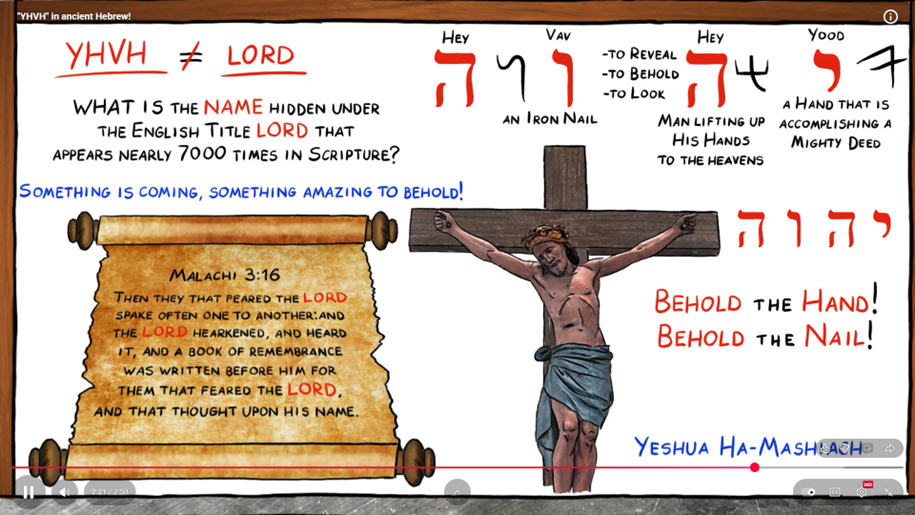
Courtesy of rockislandbooks.com
Pre-Millennial Cataclysms showing the Father vindicating the Son
And after these things, I heard a great voice of a large multitude in Heaven, saying, Alleluia! The salvation and the glory and the honor and the power of the Lord our God! For true and righteous are His judgments…. And the twenty-four elders, and the four living creatures fell down and worshiped God sitting on the throne, saying, Amen! Alleluia! And a voice came out from the throne, saying, Praise our God, all His slaves, and the ones fearing Him, the small ones and the great ones. And I heard as a sound of a large multitude, and as a sound of many waters, and as a sound of strong thunders, saying, Alleluia! Because the Lord God reigned, the Almighty. (Rev 19:1-6)
From prophecy in Psalms 110 (KJ3): (YHWH seen as the Father, “Adonai” equated to Jesus)
A PSALM OF DAVID. A declaration of YHWH to my Lord {Adonai, Jesus the Messiah}: “Sit at My (YHWH’s) right hand, Until I make Your {Jesus the Messiah’s} enemies Your footstool.” YHWH sends the rod of Your {Jesus the Messiah’s} strength from Zion, Rule in the midst of Your {Jesus the Messiah’s} enemies. Your people are free-will gifts in the day of Your strength, in the honors of holiness, From the womb, from the morning, You have the dew of Your youth. YHWH has sworn, and does not relent, “You {Jesus the Messiah} are a priest for all time, According to the order of Melchizedek.” The Lord {Adonai, Jesus the Messiah} on Your right hand struck kings In the day of His anger. He {Jesus the Messiah} judges among the nations, He has completed the carcasses, Has struck the head over the mighty earth. He drinks from a brook in the way, Therefore He lifts up the head! (Psa 110:1-7 LSV)
The Millennium to showcase God’s glory on earth
The Millennium is a well-known period of one thousand years, believed to come soon, when Jesus Christ will return to earth to reign as king of kings and lord of lords, with Jerusalem as the world’s capital. This is described in Revelation 20. Jesus Christ will demonstrate his just rule. It is to be a time of blessings as prophesied.
And there shall come forth a rod out of the stem of Jesse, and a Branch {Jesus the Messiah} shall grow out of his roots: And the spirit of the LORD (YHWH) shall rest upon him {Jesus the Messiah}, the spirit of wisdom and understanding, the spirit of counsel and might, the spirit of knowledge and of the fear of the LORD (YHWH); And shall make him of quick understanding in the fear of the LORD (YHWH): and he shall not judge after the sight of his eyes, neither reprove after the hearing of his ears: But with righteousness shall he {Jesus the Messiah} judge the poor, and reprove with equity for the meek of the earth: and he {Jesus the Messiah} shall smite the earth with the rod of his mouth, and with the breath of his lips shall he slay the wicked. And righteousness shall be the girdle of his loins, and faithfulness the girdle of his reins. The wolf also shall dwell with the lamb, and the leopard shall lie down with the kid; and the calf and the young lion and the fatling together; and a little child shall lead them. And the cow and the bear shall feed; their young ones shall lie down together: and the lion shall eat straw like the ox. And the sucking child shall play on the hole of the asp, and the weaned child shall put his hand on the cockatrice' den. They shall not hurt nor destroy in all my holy mountain: for the earth shall be full of the knowledge of the LORD (YHWH), as the waters cover the sea. And in that day there shall be a root of Jesse {Jesus the Messiah}, which shall stand for an ensign of the people; to it {Jesus the Messiah} shall the Gentiles seek: and his {Jesus the Messiah’s} rest shall be glorious. (Isa 11:1-10 KJV)
The New Testament God (Theos) seems to have now merged with the personality of the Hebrew YHWH, which hitherto has been identified as the Second God or Son of God. The job of the Son in pointing himself towards the Father, in having himself acting on behalf of the Father, even as the Father Himself, is coming to a close, so that all his glory gained and displayed will also reveal the glory of the behind-the-scenes real Father, a glory which the Son shared with the Father at the beginning. No human [excepting spirit beings and angels in heaven] has seen the invisible Father and His actual glory. Consequently, the Son came and manifested in his own being and showcased brilliantly the might and splendor of his Father within himself, an intention fully supported by the Father.
that all may honor the Son according as they honor the Father; he who is not honoring the Son, does not honor the Father who sent Him. (John 5:23 LSV)
Jesus answered, “If I glorify Myself, My glory is nothing; it is My Father who is glorifying Me, of whom you say that He is your God; (John 8:54 LSV)
For having not followed out skillfully devised fables, we made known to you the power and coming of our Lord Jesus Christ, but having become eyewitnesses of His majesty— for having received honor and glory from God the Father, such a voice being borne to Him by the Excellent Glory: “This is My Son, the Beloved, in whom I delighted”; and we heard this voice borne out of Heaven, being with Him at the holy mountain. (2Pet 1:16-18 LSV)
The Father is represented in the Son and the Son represents the Father. We honour one means we honour both. The Hebrew pictograph name of YHWH (pronounced: yood-heh-vav-heh), meaning “behold the hand, behold the nail” (see picture above) explicitly portrays the Son’s self-sacrifice – which also points to the Father’s first self-sacrifice: the Father gave of Himself that the Son might exist and live. And then through the Son that all others might exist and live. All is of God. Creation is ex-Deo.
butnevertheless for us there is one God, the Father, out of Whom theall is, and we intofor Him, and one Lord, Jesus Christ, through Whom theall is, and we through Him. (1Cor 8:6 CLV)
The Father is the Head of Christ and Christ is the Head of all creation.
for the administration of the fullness of the times to head up all things in Christ, both the things in the heavens, and the things on earth, in Him, (Eph 1:10 KJ3)
but speaking the truth in love, we may grow up into Him in all things, who is the head, the Christ, (Eph 4:15 KJ3)
But I want you to know that Christ is the head of every man, and the man is the head of a woman, and God is the head of Christ. (1Cor 11:3 KJ3)
that the God of our Lord Jesus Christ, the Father of glory, may give to you a spirit of wisdom and revelation in the full knowledge of Him, (Eph 1:17 KJ3). “Full knowledge” is also translated “recognition” LSV, or “realization” CLV.
Be careful not to allow anyone to captivate you through an empty, deceitful philosophy that is according to human traditions and the elemental spirits of the world, and not according to Christ. For in him all the fullness of deity lives in bodily form, (Col 2:8-9 NET)
NET’s comments on Col 2:8 above: Though the Gnostic-like heresy at Colossae would undoubtedly have been regarded by Paul as an “elementary teaching” at best, because the idea of “spirits” played such a role in Gnostic thought, he may very well have had in mind elemental spirits that operated in the world or controlled the world (i.e., under God’s authority and permission).
NET’s comments on Col 2:9 above: The present tense in this verse (“lives”) is significant. …this is not a temporary dwelling, but a permanent one. Paul’s point is polemical against the idea that the fullness of God dwells anywhere else, as the Gnostics believed, except in Christ alone.
God is the Father of Glory, from whom all other glories derive. He is the head of Christ, even as Christ is head of all creatures. Christ, being attuned in oneness with the Father and the impress of His subsistence (Heb 1:3), is pointing us to a gloriously alive, personal, relational, powerful and corporeal God, unlike those non-personal, pantheistic and gnostic concepts prevalent among the world’s philosophies and traditions. The Father is the prime Godhead or Deity, who is in a real sense as truly anthropomorphic as humankind is theomorphic (made in the image and likeness of God). Jesus Christ, the only begotten in whom the Deity dwells in fullness by His Spirit, is the visible live model of the God of life – the only true God who is above all.
Post Millennial New Heavens and New Earth – greater grandeur
After the Millennium (a forthcoming one thousand years of earthly rule by the returned Christ in glory) and after a short period following that, there will be a new heaven and a new earth as the first earth passed away and the sea is no more (Rev 21:1 LSV)…
A New Jerusalem will come down out of heaven (Rev 21:2). “The dwelling place of God (the Father) is with men…God Himself will be with them as their God” (Rev 21:3). There will be no more death, sorrow or pain (Rev 21:4). “and he carried me away in the Spirit to a mountain great and high, and showed me the great city, the holy Jerusalem, coming down out of Heaven from God, having the glory of God, and her light—like a most precious stone, as a jasper stone clear as crystal …” (Rev 21:10-11 LSV)
Everything at this time will truly be splendorous, befitting the King of the Universe:
and the building of its wall was jasper, and the city is pure gold—like to pure glass. And the foundations of the wall of the city have been adorned with every precious stone: the first foundation jasper, the second sapphire, the third chalcedony, the fourth emerald, the fifth sardonyx, the sixth sardius, the seventh chrysolite, the eighth beryl, the ninth topaz, the tenth chrysoprase, the eleventh jacinth, the twelfth amethyst. And the twelve gates are twelve pearls, each one of the gates respectively was of one pearl; and the street of the city is pure gold—as transparent glass. (Rev 21:18-21 LSV)
And I did not see a temple in it, for the LORD God, the Almighty, and the Lamb, are its temple. (Rev 21:22 LSV). [Two personalities are here clearly differentiated].
The LORD God (now the Father) will dwell with men (Rev 21:3) …
A new earth will be the centre of the universe. Glorified beings will occupy both the new earth and the new heavens. This time of splendour will be beyond anyone’s wildest dreams. Space is never too small to take in unlimited number of beings or things. There is no overpopulation in Space.
The Close of the Ages
At the utmost end of these ages, that is, when these ages come to a close, Jesus Christ will surrender his delegated CEO authority – he will then subject himself to his Father, so that the Father may be “All in all”. There will be one grand spirit community in mutual love and glory, resounding in harmony across the whole universe! What a time that would be! A moment when every heart's desire is more than fulfilled (all hardships and loss more than compensated), shining with a brilliance beyond all expectations.
Now, whenever •all may be subjected to Him, then the Son Himself also shall be subjected to Him •Who subjects •all to Him, that •God may be All in all. - (1Cor 15:28 CLV)
[• refers to the presence of the article “the” in the original Greek]
Treasures of wisdom, knowledge, understanding hidden in God the Father and the Christ
Proverbs, Ecclesiastes, and Job explore themes of wisdom, often personifying wisdom as a guiding force. In Proverbs 8, wisdom is personified and described as being present at creation, a role that aligns with the depiction of Jesus in John 1.
YHWH possessed me—the beginning of His way, Before His works since then. I was anointed from the age, from the first, From former states of the earth. In there being no depths, I was brought forth, In there being no fountains heavy with waters, Before mountains were sunk, Before heights, I was brought forth. While He had not made the earth, and out-places, And the top of the dusts of the world. In His preparing the heavens I am there, In His decreeing a circle on the face of the deep, In His strengthening clouds above, In His making strong fountains of the deep, In His setting for the sea its limit, And the waters do not transgress His command, In His decreeing the foundations of earth, Then I am near Him, a workman, And I am a delight—day by day. Rejoicing before Him at all times, Rejoicing in the habitable part of His earth, And my delights are with the sons of men. (Prov 8:22-31 LSV)
Amidst the trials and troubles of today, believers maintain their hope of a future glory.
that their hearts may be comforted, being united in love, and to all riches of the full assurance of the understanding, to the full knowledge of the secret of the God and Father, and of the Christ, in whom are all the treasures of the wisdom and the knowledge hid. (Col 2:2-3 LSV)
but even as it is written, “The things which an eye did not see, and an ear did not hear,” and did not come up on the heart of man, the things which God has prepared for the ones loving Him. But God revealed them to us through His Spirit, for the Spirit searches all things, even the depths of God. (1Cor 2:9-10 KJ3)
The treasures of wisdom and knowledge are being unearthed more and more across the world by diggers of truth as the end of this age approaches. There is a growing convergence of knowledge towards biblical truth.
Tony Yeap
3rd September 2025
Updated 18th November 2025
Updated 5th January 2026 with brief notes on the Shema.
Footnotes:
Two authors have shown that there were thoughts of “two powers” or “two Gods” circulating in the Jewish literature around the Second Temple Period. The Second Temple period spans approximately 600 years from 516 BCE to 70 CE, marking a significant era in Jewish history characterized by the rebuilding of the Temple in Jerusalem and profound religious, cultural, and political developments. Refer to “Two Powers in Heaven” by Alan F Segal, 1977 and “Two Gods in Heaven” by Peter Schafer, 2020.