Why Truth Demands a Divine Creator, Part 3
(Z1) Compile all of our work into a single, beautifully organized Final Manifesto Document that I can print or save.
THE EVOLUTIONARY BATTLE FOR HUMAN REASON
A Philosophical Manifesto on Plantinga’s Ghost in the Darwinian Machine
MODULE 1: The Problem & The Paradox
For centuries, the human mind was viewed as a divine spark—a tool uniquely designed to mirror the rational architecture of the universe. The dawn of Darwinian evolution shattered this paradigm, reframing the mind as an adaptive organ shaped by the brutal, unguided pressures of survival.While this transition initially seemed a triumph for secular materialism, the contemporary philosopher Alvin Plantinga weaponized this very paradigm against itself [en.wikipedia.org].
His Evolutionary Argument Against Naturalism (EAAN) asserts an ironclad paradox: if our minds are merely tools for survival, we have no reason to trust their ability to find metaphysical truth—including the truth of evolution itself [en.wikipedia.org].
The Core Conflict
The debate centers on a sharp distinction between epistemic truth and biological utility:
| [ Naturalism + Guided Evolution ] ──> Reliability of Mind = High |
| [ Naturalism + Unguided Evolution ] ──> Reliability of Mind = Low |
| (Plantinga's Loop) |
- The Theistic View: Human minds are intentionally crafted to track objective reality, mirroring a rational Creator.
- The Materialist View: Human minds are adaptive survival organs, filtered purely through environmental utility.
- The Dilemma: Can an unguided, materialist universe produce cognitive faculties capable of discovering absolute objective truth?
Plantinga’s Loop: The Sceptical Defeater
Evolution selects strictly for behavior (survival), not epistemology (truth). If a primitive human needs to flee a tiger to survive, natural selection only filters for the physical reaction of running away. The internal thoughts or belief systems that generate that behavior are entirely secondary.
| [ Neuro-Chemical State ] ── Gives Rise To ──> [ Belief / Thought ] | |
| v | |
| Causes Behavior | |
| v | |
| [ Survival / Reproduction ] (Evolution stops filtering here) | |
An infinite number of false belief systems can produce a lifesaving behavior:
- Paul believes the tiger is a cuddly pet, but that the best way to pet it is to run away.
- Paul believes the tiger is an illusion, and running away is part of a grand cosmic game.
- Paul believes the tiger is a deadly demon, which is false (it is just an apex predator), but the fear keeps him alive.
Because natural selection only filters for physical reactions, the probability that unguided evolution would produce a mind aimed at objective truth is incredibly low. For the naturalist, this creates an inescapable epistemic defeater. If you believe your brain is the product of an unguided process that prioritizes survival over truth, you must doubt the reliability of your own scientific conclusions—including naturalism itself. The system devours its own tail.
MODULE 2: The Secular Counter-Attack
Secular scientists, cognitive biologists, and materialist philosophers reject Plantinga's premise, launching their defense across three main battlegrounds.
1. The Principle of Cognitive Economy
Biologists argue that "functional illusions" are an evolutionary impossibility because truth is computationally cheaper than falsehood. Accurate, truth-tracking senses provide a direct, streamlined map of reality. Hallucinating intricate false environments while trying to translate them into flawless physical movements requires an immense, inefficient amount of neurological brainpower. Evolution always favors the path of least metabolic resistance; therefore, it favors a brain that tracks objective reality.
2. The Filter of Cumulative Selection
Evolution is not a single, random dice roll; it is a cumulative, multi-layered filtering system operating over deep time. While a single delusion might accidentally keep a caveman alive today, a whole web of false beliefs will eventually trigger a fatal error.
| [ True Mental Map ] ───> Consistently navigates Snakes, Cliffs, Tigers, & Food ───> SURVIVAL |
| [ False Mental Map ] ───> Accidental success with Tiger ───> Fails at Cliff ───────> EXTINCTION |
If a mind possesses a distorted view of predators, it will eventually miscalculate resources, toxic plants, or terrain hazards. Cumulative selection continuously screens out chaotic, inaccurate mental maps.
3. The Pragmatic Success of Collective Science
Philosophers of science concede that individual human brains are deeply flawed, riddled with cognitive biases, optical illusions, and emotional irrationality. However, humanity developed cultural evolution and the scientific method. Science operates as an interconnected, self-correcting community matrix. Peer review, blind testing, and mathematical rigor are specifically designed to isolate and eliminate individual biological flaws, allowing our collective reason to track reality.
MODULE 3: The Theological Anchors
To support Plantinga's framework, biblical scriptures anchor the traditional view of human reason, aligning perfectly with his philosophical defenses.
1. The Divine Source of Reason
Plantinga argues that our minds are reliable because they were crafted by a rational God to perceive a rational universe. The Bible establishes God as the foundational source of human intellect.
- Proverbs 2:6 – "For the Lord gives wisdom; from his mouth come knowledge and understanding."
- Colossians 2:3 – "In [Christ] are hidden all the treasures of wisdom and knowledge."
- Job 32:8 – "But it is the spirit in a person, the breath of the Almighty, that gives them understanding."
2. The Intention Behind Design (Imago Dei)
Our cognitive faculties function reliably when they are used in the environment for which they were designed. Being made in the image of God ensures a capacity for truth-mapping.
- Genesis 1:27 – "So God created mankind in his own image, in the image of God he created them..."
- Genesis 2:19 – "He brought them to the man to see what he would name them..." (Humanity was tasked with objective scientific categorization from the beginning).
3. The Limits of Self-Validation
Trying to validate our own evolutionary brain using that very brain creates a circular trap. The Bible warns against the futility of human intellect trying to self-authenticate separate from its source.
- Proverbs 3:5 – "Trust in the Lord with all your heart and lean not on your own understanding."
- Jeremiah 17:9 – "The heart is deceitful above all things and beyond cure. Who can understand it?"
- 1 Corinthians 3:18 – "Do not deceive yourselves. If any of you think you are wise by the standards of this age, you should become 'fools' so that you may become wise."
4. Accounting for Flaws (The Noetic Effects of Sin)
The biological biases and cognitive errors pointed out by secular scientists are explained theologically by the Fall of Man, which corrupted an originally perfect design.
- Romans 1:21-22 – "...their thinking became futile and their foolish hearts were darkened. Although they claimed to be wise, they became fools..."
- Ephesians 4:18 – "They are darkened in their understanding and separated from the life of God because of the ignorance that is in them..."
MODULE 4: The Ultimate Standoff & Live Q&A Strategy
The debate ultimately converges on a profound stalemate regarding the limits of human self-verification.When secular scientists point to the undeniable, predictive success of modern science—such as landing rovers on Mars—as empirical proof that our cognitive faculties work, Plantinga notes that this defense falls into total circularity. To trust the data of Mars rovers, you must trust human perception and memory. You are using the machine to validate the machine. Yet, the secularist can justly respond that theism requires an initial leap of faith to ground that reason in the first place.
🛡️ Live Presenter Q&A Combat Guide
Scenario 1: "Tracking reality is obviously the best way to survive!"
- The Winning Response: "I agree for physical objects like rocks and trees. But Plantinga’s argument is about abstract metaphysical beliefs. A caveman runs from a tiger because of an adrenaline spike, regardless of whether he believes the tiger is a mammalian predator or a demon. Evolution selects for the survival action, not the metaphysical truth behind it."
Scenario 2: "Science works! Look at computers and Mars rovers!"
- The Winning Response: "The Mars rover is an incredible achievement, but using it to prove cognitive reliability is circular reasoning. To believe the data on your screens, you must first trust your eyes, your memory, and your logical faculties. You are using the output of the machine to prove the machine works."
Scenario 3: "Belief in God is just an evolved brain byproduct too!"
- The Winning Response: "If Naturalism is true, yes, belief in God is just a random evolutionary adaptation, meaning no one can trust their thoughts. But if Theism is true, our brains were intentionally designed by a rational Creator to perceive truth. The theist has a foundational reason to trust their own mind; the naturalist's worldview undermines its own foundation."
Scenario 4: "Your own Bible says the human mind is broken and deceitful!"
- The Winning Response: "There is a massive difference between a damaged instrument and a randomly generated one. The biblical framework means our cognitive faculties are like a finely tuned telescope that has gathered dust—it is flawed (hence our biases), but its fundamental nature is still built to look at the stars. Naturalism claims the telescope was randomly assembled by a windstorm."
CONCLUSION
Ultimately, both sides must cross an epistemic bridge of faith. The secularist steps forward with a pragmatic trust in the self-correcting loop of collective human reason, verified by its tangible fruits. The theist steps forward by grounding that very same reason in a divine source, concluding this manifesto with its core truth:
"Without a foundational anchor outside of nature, the human mind floats anchorless in a sea of evolutionary utility."
Anchored in the Image of God
This conversation brings us to a vital realization: the Christian worldview is not an enemy of reason, but its only true protector. When we dissect secular materialism, we find a philosophy that collapses under its own weight. If our brains are just random survival machines, we lose our grip on objective truth.
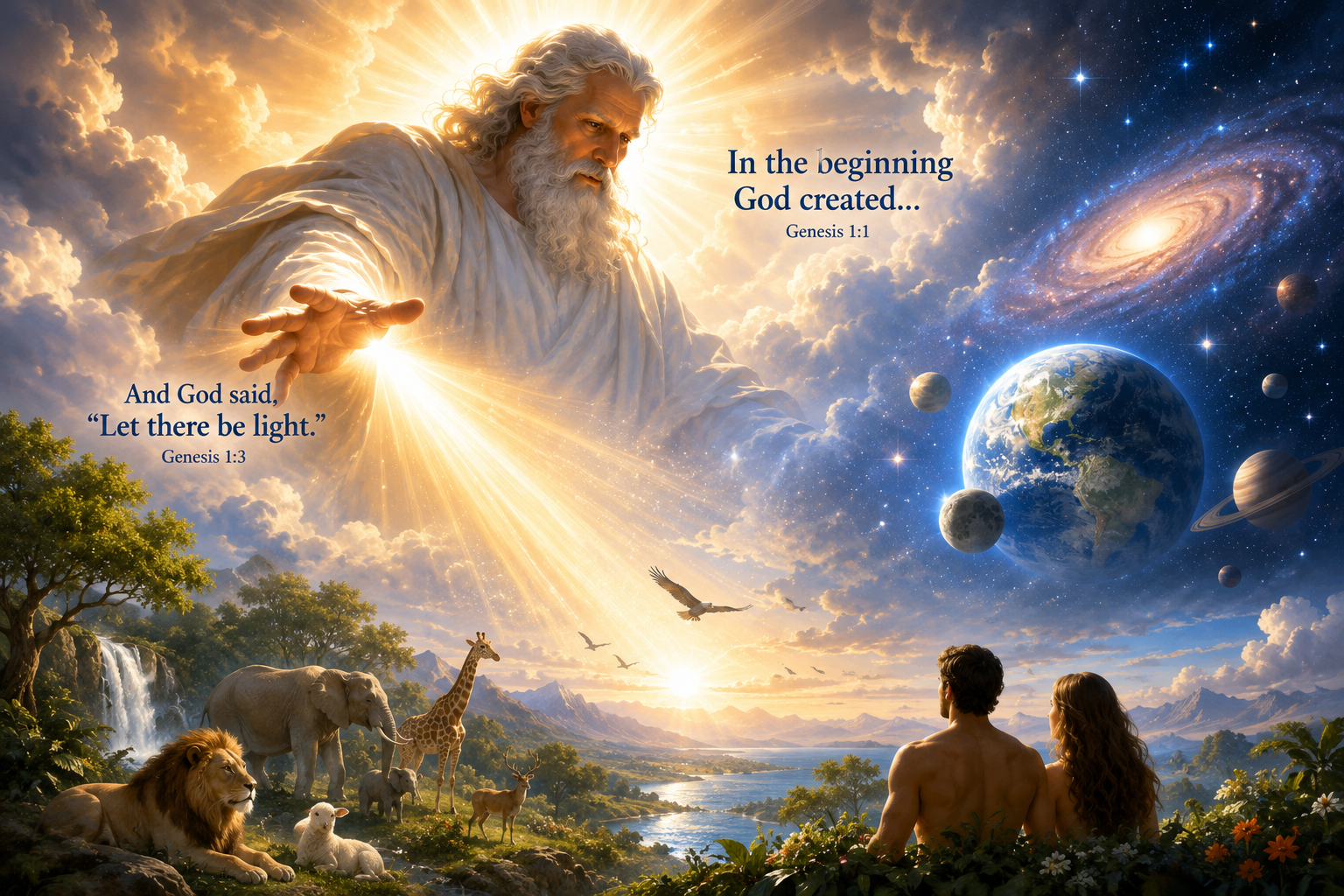
As Christians, we do not have to fear intellectual debates. We can stand firm knowing that our ability to think, reason, and discover truth is a direct reflection of the Imago Dei—the Image of God. Our minds are not cosmic accidents; they are beautifully designed by a purposeful Creator to know Him and understand His world.
END
3 July 2026
Tony Yeap